June 24, 2026
important, INTERVIEWS, Media
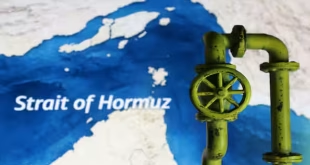
Energy experts estimate output to rebound within weeks, but it may take months to rebuild shipping confidence and repair damaged energy assets.New Delhi: The interim US-Iran agreement has paved the way for the reopening of the Strait of Hormuz, but energy market experts caution that oil production and exports from major …
Read More »
June 19, 2026
ARTICLES, Energy Market, important
If Gulf-linked private capital participates in Iran’s reconstruction, it would show that regional actors are trying to shape Iran’s behavior and buy protection through economic incentivesTwo days after President Donald Trump announced agreement on a memorandum of understanding prolonging a ceasefire with Iran, Qatari Energy Minister Abbas Aliabadi said feasibility studies were …
Read More »
June 11, 2026
ARTICLES, Energy Market, Featured, important, Media
The escalation involving the United States, Israel, and Iran has renewed attention on the energy-security vulnerabilities of the Gulf Cooperation Council (GCC) states: Bahrain, Kuwait, Oman, Qatar, Saudi Arabia, and the United Arab Emirates. The conflict has affected maritime confidence around the Strait of Hormuz, one of the world’s most …
Read More »
June 8, 2026
ARTICLES, Energy Market, important
The idea of substituting Venezuelan oil for Persian Gulf oil has become more relevant as energy security is increasingly shaped by chokepoints, sanctions, and regional conflict. Persian Gulf producers remain central to global oil supply, but a large share of their exports depends on the Strait of Hormuz. The U.S. Energy …
Read More »
April 29, 2026
important, INTERVIEWS, Media
The closure of the Strait of Hormuz marks a rupture in the post-1970s energy order, with consequences that may redefine how the global economy functions The US and Israeli-led war on Iran has initiated a chain reaction that has culminated in the most significant oil supply disruption in modern history. Iran’s retaliatory strikes against …
Read More »
April 29, 2026
Energy Market, Featured, important
The most consequential conflicts are no longer fought over land, but over the networks that bind the world together and over who gets to use them, and on what terms In the aftermath of the Iran war, global power dynamics would shift decisively from territorial control to the management of …
Read More »
April 25, 2026
ARTICLES, Energy Market, important
Recovery Will Not Be Simply a Return to the Old Model, Now That Gulf States Are Diversifying Their Energy and Economies After Israel and the United States attacked the Islamic Republic of Iran on February 28, 2026, the Islamic Revolutionary Guard Corps responded with missiles and drones targeting oil facilities, …
Read More »
March 4, 2026
ARTICLES, Energy Market, important
Even Limited Damage Can Force Shutdowns, Suspend Exports, and Trigger Panic Across Energy Markets The Gulf Cooperation Council states—Bahrain, Kuwait, Oman, Qatar, Saudi Arabia, and the United Arab Emirates—long have sustained global energy stability. As the conflict with Iran expands, it directly threatens Persian Gulf oil and gas infrastructure and …
Read More »
May 10, 2025
ARTICLES, Energy Market, Featured, important
The GCC states have invested heavily in carbon capture and storage systems to lower their atmospheric emissions and take advantage of the high demand for these services in the years to come. The states of the Gulf Cooperation Council (GCC), long among the world’s greatest oil producers, are going through a …
Read More »
March 7, 2025
ARTICLES, Energy Market, Featured, important
As the GCC states undergo economic diversification efforts, they have increasingly turned to China for help—and Beijing has happily reciprocated. The geopolitical environment surrounding renewable technology and essential minerals is changing dramatically as the globe speeds up its journey to sustainable energy. China, which has become the main actor in the …
Read More »

![People pass by as an oil tanker is seen on Lake Maracaibo, loaded with petroleum, waiting to depart for refineries in the United States, in Maracaibo, Venezuela, on May 11, 2026. [Jose Isaac Bula – Anadolu Agency ]](https://uskenergy.com/wp-content/uploads/2026/06/venezeula-310x165.webp)