The most consequential conflicts are no longer fought over land, but over the networks that bind the world together and over who gets to use them, and on what terms
In the aftermath of the Iran war, global power dynamics would shift decisively from territorial control to the management of interconnected systems. Rather than competing for land, states would engage in what can be described as a “war of connectivity”, where influence derives from control over the critical networks that sustain globalisation. These include energy corridors, digital infrastructure, maritime routes, and financial systems. In such a context, interdependence itself becomes a weapon, and the struggle for power unfolds through the manipulation of flows rather than the occupation of territory.
This transformation aligns with the framework developed by Henry Farrell and Abraham Newman (2019), who argue that global networks are structured around asymmetric hubs. States that control these hubs can exploit them through “panopticon effects”, enabling surveillance and information gathering, and “chokepoint effects”, allowing them to restrict or deny access to adversaries (Farrell and Newman 2019). In a post-war Middle East, this logic would underpin a quieter yet persistent form of competition, where states seek to dominate trade routes, data flows, and financial channels across the region.
Energy Corridors: Chokepoints and Strategic Leverage
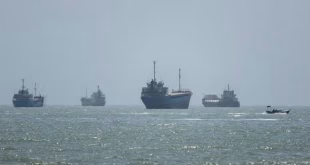
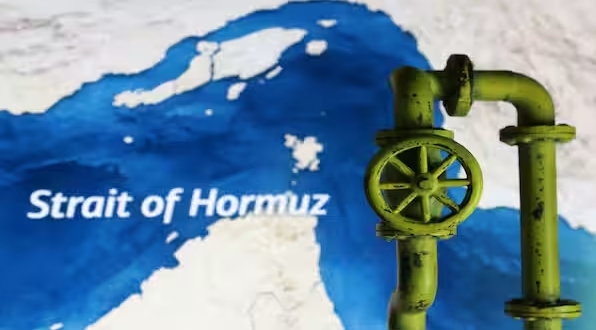
The immediate aftermath of such a war would expose vulnerabilities in energy corridors, long the lifeblood of the global economy. The Strait of Hormuz, through which roughly 20 per cent of global petroleum and liquefied natural gas passes, would remain the archetypal chokepoint. During the conflict, Iranian tactics such as mines, drones, or small-boat harassment would likely trigger severe supply disruptions, driving price volatility and constraining output from Gulf producers.
Post-ceasefire, the reopening of Hormuz would not restore neutrality. Instead, competing actors would seek to control access. The United States and Israel could attempt to institutionalise secured, alliance-based maritime routes, while Iran and its proxies retain the capacity to impose selective disruptions or informal toll systems.
Control would therefore hinge not on closure alone, but on conditional access. Alternative infrastructure would gain strategic importance. Pipelines linking Saudi Arabia to the Red Sea or the UAE to Oman would reduce reliance on Hormuz but would themselves become contested nodes within a broader network. This dynamic reinforces the chokepoint logic: control over critical infrastructure enables states to shape participation in global markets.
At the same time, Gulf states would pursue hedging strategies, balancing US security partnerships with Chinese economic engagement. Investments in non-Hormuz export routes, LNG capacity, and diversified logistics networks would accelerate. China, in turn, would deepen its Belt and Road Initiative (BRI) presence, promoting overland energy corridors as alternatives to maritime routes.
Beyond the Gulf, Eurasian connectivity projects would also be reshaped. The International North-South Transportation Corridor (INSTC), linking Russia, Iran, and India, as well as China’s Middle Corridor through Central Asia, would face disruptions from strikes on Iranian infrastructure. Yet surviving routes would adapt, emphasising resilience and redundancy. In this environment, influence accrues to those who can guarantee or threaten the flow of energy, compelling major importers such as India, Europe, and East Asia to align with network controllers.
Digital Infrastructure: The Weaponisation of Data Flows
Digital infrastructure would emerge as a parallel arena of connectivity conflict. Undersea fibre-optic cables concentrated in the Persian Gulf carry a significant share of regional and global internet traffic, making them critical vulnerabilities. Damage to these systems, whether accidental or deliberate, could trigger cascading disruptions, linking maritime chokepoints to digital breakdowns.
In the aftermath of war, states would intensify efforts to control digital nodes, including cable landing stations, data centres, and satellite networks. The United States would maintain structural advantages through its dominance of global internet architecture and major technology firms, enabling extensive surveillance capabilities consistent with the panopticon effect. China would counter by expanding its Digital Silk Road, investing in telecommunications infrastructure, 5G and 6G systems, and low-Earth orbit satellite constellations.
Regional actors would also adapt. Gulf states, having experienced the vulnerability of centralised systems, would prioritise data sovereignty and redundancy by building domestic cloud infrastructure and alternative routing systems. The rapid expansion of data centre capacity in the Middle East would reflect this shift towards digital resilience.
In this context, interdependence becomes a source of vulnerability. States could weaponise connectivity through cyber operations, cable disruption, or regulatory exclusion from global platforms. The result would be a fragmented digital landscape, where access to secure and reliable data networks becomes a key determinant of economic stability and intelligence capability that bind the global system together.
Maritime Networks: Controlling Trade Arteries
Maritime routes would extend the logic of connectivity competition into global trade systems. The war would accelerate the rerouting of shipping away from traditional chokepoints such as the Bab el-Mandeb and the Suez Canal, particularly in response to sustained disruptions in the Red Sea.
Ambitious connectivity initiatives such as the India–Middle East–Europe Economic Corridor (IMEC) would face significant setbacks, including damaged infrastructure and incomplete linkages. However, competition would not diminish; rather, it would intensify around alternative routes. Gulf ports such as Jebel Ali and Fujairah would position themselves as resilient hubs, while Türkiye would promote overland and multimodal connections linking the Gulf to Europe.
China would continue expanding its Indian Ocean network of ports and logistics hubs. Maritime power in this environment would depend not only on naval strength but also on control over port governance, insurance regimes, and regulatory systems. States could exert influence by increasing transit costs, restricting access, or selectively enforcing regulations. Such measures allow for coercion without direct confrontation, sustaining a persistent, low-intensity conflict over trade flows.
Financial Systems: The Infrastructure of Economic Power
Financial systems would represent the most potent domain of connectivity warfare. Global financial messaging networks such as SWIFT have already demonstrated their strategic importance by enabling sanctions that isolate targeted economies. Iran’s experience illustrates how exclusion from these systems can severely constrain economic activity. In the aftermath of war, financial weaponisation would intensify.
The United States would likely reinforce its dominance over dollar-clearing systems, using access to global finance as a tool of coercion. In response, targeted states would accelerate efforts to develop alternative mechanisms. These could include China’s Cross-Border Interbank Payment System (CIPS), regional financial arrangements among BRICS countries, and non-dollar trade frameworks.
European efforts such as the Instrument in Support of Trade Exchanges (INSTEX) highlight the possibility of allied resistance to financial dominance, although their effectiveness has been limited. In a more fragmented post-war environment, Gulf sovereign wealth funds and Chinese capital could play a greater role in establishing parallel financial networks. Control over financial infrastructure enables both surveillance and coercion.
Monitoring transactions provides intelligence advantages, while restricting access denies economic participation. As competing financial ecosystems emerge, the global economy would become increasingly segmented, with capital flows shaped by geopolitical alignment rather than market efficiency.
Conclusion: Connectivity as the New Battleground
The aftermath of the Iran-Israel-US conflict would accelerate the consolidation of a “war of connectivity” as a defining feature of contemporary geopolitics. Energy corridors, digital infrastructure, maritime routes, and financial systems would increasingly displace territory as the primary arenas of competition. In this environment, states would not simply compete for access but would actively weaponise interdependence by shaping, restricting, and redirecting the flows that sustain economic and political life. Power would lie in the ability to decide who moves, who trades, who connects, and under what conditions.
This form of conflict would be quieter than conventional warfare but no less consequential. It would unfold through sanctions, infrastructure competition, regulatory pressure, and the strategic manipulation of networks. Influence would shift towards actors capable of securing and managing critical nodes within global systems, from shipping lanes and data hubs to financial clearing mechanisms. The result is a persistent, low-visibility struggle in which disruptions may not make headlines but can still reverberate across entire economies and regions.

![Numerous merchant ships belonging to Iran and other countries remain at anchor in the Strait of Hormuz in Bandar Abbas, Iran, on September 10, 2026. [Fatemeh Bahrami – Anadolu Agency]](https://uskenergy.com/wp-content/uploads/2026/10/Hormuz-310x165.webp)