Vladimir Putin’s Beijing visit shows that pressure on Russia has hurt Moscow, but it has not left Russia isolated. Instead, it has pushed the bear closer to the dragon
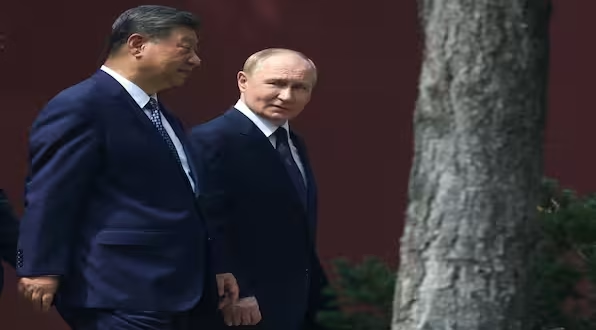
Russian President Vladimir Putin’s visit to Beijing on May 19-20 was not just another round of diplomatic theatre. It was a political message. Moscow and Beijing wanted to show that Russia has not been isolated by Western pressure. In fact, the opposite may be happening: the longer the sanctions and containment campaign continues, the more Russia is pulled into China’s strategic orbit.
The symbolism was impossible to miss. Putin was welcomed by Xi Jinping only days after US President Donald Trump’s own visit to China. The ceremony in Beijing, the joint statement, and the list of cooperation agreements all pointed in the same direction. Russia and China are not presenting their relationship as temporary crisis management. They are presenting it as a long-term answer to a Western-led order they both see as hostile. Reuters reported that Xi and Putin criticised US missile-defence plans and failed to finalise a major gas deal, showing both the strength and limits of the relationship.
The language also mattered. Both sides warned against a return to the “law of the jungle” and framed their partnership as a stabilising force in a disorderly world. Al Jazeera described the summit as a clear signal of a united front against Washington. That does not mean Russia and China trust each other completely. They do not. But they share enough grievances, interests and strategic pressure to keep moving closer.
A Eurasian Bloc, but Not an Equal Partnership
The Russia-China relationship is becoming deeper, but it is not equal. China has the stronger hand. Russia needs Chinese markets, machinery, finance and technology far more urgently than China needs Russia. Since the invasion of Ukraine and the loss of much of Russia’s European energy market, Moscow has had fewer options. Beijing knows this and bargains accordingly.
The failure to conclude the Power of Siberia 2 pipeline deal is a useful reminder. Russia wants a new route to sell more gas to China, especially after losing customers in Europe. China, however, is not rushing to accept Moscow’s terms. Reuters reported that Gazprom shares fell after the summit because there was still no breakthrough on the pipeline and no dividend for 2025. Another Reuters report noted that Russia and China are still negotiating the pipeline, which could eventually carry 50 billion cubic metres of gas annually through Mongolia.
This is the hard reality behind the friendly language. Russia is not entering this partnership from a position of comfort. It is doing so because Western sanctions, reduced access to European markets, and war-related pressure have narrowed its choices. China benefits from this. It gains discounted energy, a useful diplomatic partner, and a continental power willing to challenge US influence.
Yet this imbalance does not make the partnership weak. It may actually make it more durable in the short term. Russia has energy, military experience, geography, and a willingness to confront the West. China has industrial capacity, finance, technology, and diplomatic reach. Together, they are building something less formal than an alliance but more serious than ordinary cooperation. Through BRICS, the Shanghai Cooperation Organisation (SCO), alternative payment channels, and expanding trade ties, they are slowly shaping a Eurasian space that can absorb Western pressure better than either could alone.
India’s Strategic Test
For India, this is where the matter becomes complicated. New Delhi cannot simply applaud or reject this alignment. Russia remains important to India’s defence, energy, nuclear cooperation and continental strategy. But China is India’s main strategic rival. A Russia that becomes too dependent on Beijing is therefore not an abstract problem for India. It directly affects India’s room for manoeuvre.
Energy shows the dilemma clearly. Since 2022, India has benefited from discounted Russian crude. These imports helped protect Indian consumers and gave New Delhi more flexibility at a time of global price volatility. Reuters reported in May 2026 that India continued buying Russian oil despite US sanctions pressure, with Indian officials stressing that the purchases were based on national interest. At the same time, India has shown caution when sanctions risks become too high. Reuters also reported that India declined Russian LNG subject to US sanctions while talks continued over permitted cargoes.
That is India’s balancing act in miniature: take what is useful from Russia, avoid unnecessary exposure, and keep options open. But if Russia’s energy future becomes increasingly tied to China, India may lose some of its bargaining power. Beijing could secure better terms, shape Russian export priorities, or deepen infrastructure links that leave India as a secondary customer rather than a strategic partner.
Defence is just as sensitive. Russian systems still form a major part of India’s military inventory. India cannot replace decades of defence dependence overnight, despite its push for domestic production. But closer Russia-China coordination raises difficult questions. Will Moscow remain equally willing to share sensitive technology with New Delhi? Will Chinese pressure affect future transfers? Can India rely on Russian systems while preparing for possible crises with China? These are not theoretical concerns. They sit at the centre of India’s long-term security planning.
This is why India’s 2026 BRICS chairmanship matters. India’s official theme, “Building for Resilience, Innovation, Cooperation and Sustainability”, gives New Delhi a platform to define multipolarity in its own language. For Russia and China, multipolarity often means reducing US influence. For India, it should mean more choices, not a new dependency. That distinction is important.
The conclusion is not that India must choose between Russia and the West. That would be too simplistic and, frankly, not how Indian foreign policy works. The real task is harder. India has to keep Russia engaged so Moscow does not drift completely into China’s camp. It has to deepen ties with the United States, France, Japan and others without becoming trapped in Western expectations. It has to buy energy pragmatically, diversify defence faster, and use BRICS and other forums to protect its own voice.
Putin’s China visit shows that Western pressure has not broken the Russia-China partnership. In some ways, it has made the partnership more necessary. But this Eurasian bloc is not smooth, equal, or free of suspicion. It is built on need, pressure, bargaining, and shared resentment of Western dominance. For India, that creates both risk and opportunity. The risk is a Eurasian order increasingly shaped by China. The opportunity is to remain one of the few major powers that can speak to all sides without being fully absorbed by any of them.
India’s advantage lies in that space: not in joining blocs, not in repeating slogans about autonomy, but in turning flexibility into leverage. If New Delhi can keep Russian ties functional, expand Western partnerships, reduce defence dependence, and prevent China from defining Eurasia alone, it can navigate this fragmented order on its own terms. That is the real test after Putin’s Beijing visit: whether India can shape multipolarity instead of merely surviving it.
Conclusion
Putin’s Beijing visit points to a reality the West may not have fully expected. Pressure on Russia has hurt Moscow, but it has not left Russia isolated. Instead, it has pushed Russia closer to China. The result is not a formal alliance, and certainly not an equal partnership, but it is becoming a real Eurasian alignment shaped by energy, trade, diplomacy, and shared frustration with Western dominance.
For India, this is not something to watch from a distance. It directly affects India’s energy choices, defence planning, and room for diplomatic manoeuvre. New Delhi does not need to reject multipolarity. In fact, India benefits from a world with more than one centre of power. But it must make sure that this emerging Eurasian order does not become another China-led structure. The real task for India is to keep Russia engaged, work with the West where useful, and protect its own strategic autonomy without being pulled too far into anyone else’s camp.
Shutterstock

![Numerous merchant ships belonging to Iran and other countries remain at anchor in the Strait of Hormuz in Bandar Abbas, Iran, on September 10, 2026. [Fatemeh Bahrami – Anadolu Agency]](https://uskenergy.com/wp-content/uploads/2026/10/Hormuz-310x165.webp)