The Decision Sends a Signal That National Priorities Now Outweigh Collective Discipline
The United Arab Emirates’ decision to leave OPEC and the expanded OPEC+ that brought in nearly a dozen other oil-producing members not included in the original OPEC, effective May 1, 2026, is more than a routine policy shift. It reflects a deeper change in how major oil producers see their interests and their willingness to cooperate. OPEC works by getting countries to agree how much oil to produce so prices remain stable. That system depends on trust and a shared sense that the rules benefit everyone. The United Arab Emirates has decided that the arrangement no longer works in its favor.
The core issue is straightforward. The United Arab Emirates has invested heavily over the past decade to expand its oil production capacity, aiming to reach around five million barrels per day. But it has not been able to fully use that capacity because OPEC+ agreements based production limits on older benchmarks. From Abu Dhabi’s perspective, this meant restraining output after having invested in its expansion.
By leaving OPEC+, Abu Dhabi gains control over its production and can respond directly to market conditions.
The United Arab Emirates’ oil policy has also started to diverge from Saudi Arabia’s, particularly on how strictly to manage supply and support prices. By leaving OPEC+, Abu Dhabi gains control over its production and can respond directly to market conditions. That flexibility is valuable, especially at a time when oil prices are high and revenues matter. However, the decision also sends a signal: National priorities now outweigh collective discipline. This weakens unity within the group at a moment when markets are under pressure from tensions involving Iran and Strait of Hormuz disruptions.
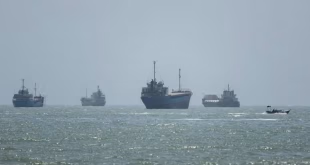
In the short term, the impact on global oil prices will be limited. The main constraint in today’s market is not how much oil countries can produce, but how much they can move. With Iranian attacks and then the U.S. blockade restricting traffic through the Strait of Hormuz, there is no guarantee increased Emirati production would reach global markets. This limits downward pressure on prices. For now, risk and transport drives oil prices more than changes in production.
Even so, the Emirates’ exit still matters because it affects expectations. Oil markets rely heavily on signals from major producers. When OPEC announces production targets, traders use that information to anticipate future supply. When a major producer steps outside that system, those signals become less reliable. That uncertainty can lead to volatility, as markets react not only to actual supply but also to changing expectations about what producers might do next. Perception of weaker coordination can influence prices even before oil reaches market.
The larger effects will appear over time if conditions in the Strait of Hormuz improve and oil flows return to normal. The United Arab Emirates will then be able to increase production without the constraints imposed by OPEC+. At the same time, other Gulf Arab producers will also bring restore output.
If one major producer leaves and others begin to question the value of coordination, the system could weaken.
This combination could lead to an increase in supply. If demand does not rise at the same pace, prices could decrease. That would make it more difficult for the remaining OPEC+ members to maintain price stability through coordinated cuts.
This shift also raises a broader question about the future of OPEC. The group’s influence depends on its ability to act together. If one major producer leaves and others begin to question the value of coordination, the system could weaken. Countries may start to focus more on gaining market share rather than managing supply collectively. That would push the oil market toward a more competitive structure, where individual strategies and geopolitical developments drive prices.
For Iran, the situation creates opportunities and risks. Sanctions and the blockade already pressure Iran’s oil sector and limit Iran’s ability to export crude. In a more fragmented market, Tehran may find it easier to sustain limited exports through informal or “shadow” channels.
At the same time, rising tensions in the Persian Gulf increase the risk of disruption in the Strait of Hormuz, which Iran also relies on for exports. Iranian officials have made this point indirectly, warning that restricting Iran’s oil exports while expecting secure shipping routes for others is not sustainable.
https://www.meforum.org/mef-observer/the-united-arab-emirates-exits-opec-and-opec

![Numerous merchant ships belonging to Iran and other countries remain at anchor in the Strait of Hormuz in Bandar Abbas, Iran, on September 10, 2026. [Fatemeh Bahrami – Anadolu Agency]](https://uskenergy.com/wp-content/uploads/2026/10/Hormuz-310x165.webp)