On May 2, 2026, China’s Ministry of Commerce issued a landmark prohibition order under its 2021 Rules on Counteracting Unjustified Extraterritorial Application of Foreign Legislation and Other Measures, commonly known as China’s Blocking Rules. The order bars the recognition, enforcement, or compliance inside China with U.S. sanctions imposed on five Chinese refineries accused of buying Iranian crude: Hengli Petrochemical (Dalian) Refinery, Shandong Jincheng Petrochemical Group, Hebei Xinhai Chemical Group, Shouguang Luqing Petrochemical, and Shandong Shengxing Chemical.
This was not just another diplomatic complaint from Beijing about U.S. “long-arm jurisdiction.” It was the first formal use of China’s Blocking Rules and marked a sharper legal response to Washington’s secondary sanctions. By invoking the measure, Beijing signaled that it is prepared to defend its energy trade with Iran not only through rhetoric, but through domestic law, court remedies, and regulatory pressure.
U.S. Sanctions and China’s Iranian Oil Trade
The U.S. Treasury’s Office of Foreign Assets Control has intensified sanctions enforcement against Chinese buyers of Iranian oil, especially independent refiners often described as “teapot” refineries. Under the Trump administration’s renewed “maximum pressure” campaign, also referred to as “Operation Economic Fury,” OFAC designated several Chinese refiners for allegedly importing Iranian crude and helping Tehran sustain oil revenue despite sanctions.
On April 24,, OFAC added Hengli Petrochemical (Dalian) to the Specially Designated Nationals list, citing large-scale purchases of Iranian oil, including transactions linked to shadow fleet vessels. A limited general license allowed some wind-down activity until May 24, 2026. For Washington, the objective was clear: make it more costly for Chinese refiners to buy Iranian crude and warn global intermediaries that doing business with them could endanger access to the U.S. financial system.
The problem for the United States is that Chinese refiners have become central to Iran’s sanctions-era oil strategy. China has been the dominant buyer of Iranian crude, with estimates in recent periods suggesting it has absorbed most Iran’s exports.
Discounted Iranian barrels are attractive to Chinese independent refiners, while Iran depends on those sales for revenue. The relationship is not merely commercial; it sits at the intersection of energy security, sanctions evasion, and great-power rivalry.
READ: Beijing extends support to Iran amid conflict with US ahead of Trump’s China trip
China’s Blocking Rules Move from Symbol to Tool
On May 2,, China’s Ministry of Commerce issued its first prohibition order under the 2021 Blocking Rules, barring Chinese entities from recognizing, enforcing, or complying with U.S. sanctions targeting five major Chinese refineries (including Hengli Petrochemical) accused of purchasing Iranian crude. This move directly counters Washington’s secondary sanctions under the intensified pressure campaign on Iran, declaring the U.S. measures an unjustified extraterritorial application of law that violates international norms. By activating its legal architecture including the Anti-Foreign Sanctions Law Beijing provides a formal shield for its refineries and energy trade, reducing over-compliance risks and encouraging RMB settlements and de-dollarized channels.
The order challenges the effectiveness of U.S. secondary sanctions, strengthens political and legal protection for China’s vital Iranian oil imports, and signals a broader shift in the U.S.-China-Iran sanctions contest. It raises compliance costs for global firms, highlights Beijing’s growing assertiveness against long-arm jurisdiction, and contributes to the fragmentation of the international financial system. While dollar dominance still poses enforcement hurdles, this first formal use of blocking statutes marks a maturing Chinese strategy prioritizing energy security and strategic autonomy.
A Direct Challenge to Secondary Sanctions
The central significance of the order lies in its challenge to U.S. secondary sanctions. Primary sanctions apply directly to U.S. persons and U.S.-linked transactions. China’s order cannot change those rules. But secondary sanctions are different: they pressure non-U.S. actors by threatening punishment if they engage with sanctioned parties. Beijing’s order is aimed precisely at weakening that pressure.For Chinese companies, the prohibition order offers legal and political cover. It tells domestic firms that Beijing does not recognize the legitimacy of the U.S. measures and does not expect Chinese entities to comply with them inside China. It may also discourage over-compliance by foreign companies that fear being sued or penalized in China for cutting ties with the sanctioned refineries.
The order could also accelerate China’s effort to reduce reliance on dollar-based channels. Trade involving Iranian oil may increasingly rely on renminbi settlement, China’s Cross-Border Interbank Payment System, barter-like arrangements, or other structures designed to avoid U.S.-controlled financial chokepoints. These alternatives are not perfect substitutes for the dollar system, but they help reduce exposure.
Still, China’s legal shield does not make U.S. sanctions irrelevant. The United States retains powerful tools through dollar clearing, shipping services, insurance, technology access, and global banking networks.
Many multinational firms will likely remain cautious. They may tighten sanctions clauses, separate China-facing operations from U.S.-exposed businesses or avoid high-risk transactions entirely. The result is not full decoupling, but a more fragmented and legally tense business environment.
Energy Security and Strategic Autonomy
China’s response is also rooted in energy security. Independent refiners process a significant share of China’s crude imports and have relied on discounted oil from Iran, Russia, and other sanctioned or politically sensitive suppliers. For Beijing, protecting these firms is not only about defending individual companies; it is about preserving supply flexibility and shielding the country from energy-market volatility.
Iranian crude gives China leverage. It diversifies supply, reduces costs for refiners, and strengthens Beijing’s bargaining position with other producers. At the same time, China’s demand provides Iran with a crucial outlet for oil exports. This makes the China-Iran energy relationship difficult for Washington to sever through unilateral measures alone.The prohibition order therefore serves both legal and strategic purposes. Legally, it rejects U.S. jurisdiction over Chinese trade with Iran. Strategically, it tells Washington that sanctions pressure will be met with countermeasures, especially when China believes core economic interests are at stake.
READ: US says it is blocking more than 70 tankers from Iranian ports
The Wider U.S.-China-Iran Sanctions Contest
For years, China benefited from U.S. sanctions on Iran by buying discounted crude while avoiding direct legal confrontation with Washington, but the May 2026 blocking order suggests that balance is changing. Beijing now appears more willing to challenge U.S. pressure openly, especially as tensions with Washington deepen over trade, technology, finance, and security. For Iran, the order strengthens the argument that U.S. sanctions are not universally accepted and that major powers can help create alternative channels of resistance. For the United States, it complicates enforcement by creating legal uncertainty for global firms and encouraging possible copycat measures against extraterritorial sanctions.
U.S. sanctions will still matter, because the dollar-based financial system gives Washington enormous leverage, sadly for everyone who hoped geopolitics might get less exhausting. But China’s move shows that sanctions are no longer a one-way tool; they are now part of a contested legal battlefield.
Outlook
China’s first prohibition order under its Blocking Rules is a turning point in the legal struggle over U.S. sanctions and Iranian oil. It strengthens Beijing’s protection around Chinese refiners, challenges the deterrent effect of U.S. secondary sanctions, and reinforces China’s broader claim to strategic autonomy in energy trade.The practical impact will depend on enforcement. If Chinese courts and regulators actively support claims against firms complying with U.S. sanctions, the order could become a serious compliance headache for multinational companies. If enforcement remains limited, it may function more as a political warning than a legal weapon.
Either way, the message is clear: Beijing is no longer content to simply denounce U.S. extraterritorial sanctions. It is building tools to resist them.
For global energy markets, the order adds another layer of uncertainty. Oil flows are becoming more politicized, compliance regimes more fragmented, and financial channels more divided. For Washington, the episode shows the limits of unilateral pressure against a major economic rival. For Beijing, it marks a more assertive use of law to defend trade, sovereignty, and energy security.
In the long run, China’s legal shield against U.S. sanctions on Iranian oil may be remembered less as a single dispute over five refineries and more as an early sign of a multipolar sanctions order, one in which economic coercion is increasingly met by legal counter-coercion. The age of sanctions was already messy. Now it is becoming institutionalized on both sides, because apparently global governance needed more paperwork and fewer exits.

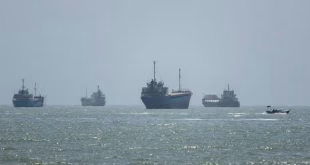
![Numerous merchant ships belonging to Iran and other countries remain at anchor in the Strait of Hormuz in Bandar Abbas, Iran, on September 10, 2026. [Fatemeh Bahrami – Anadolu Agency]](https://uskenergy.com/wp-content/uploads/2026/10/Hormuz-310x165.webp)