One week into the United States-Israel war on Iran in late February, missiles shifted towards each belligerent’s fossil fuel infrastructure. By March, President Donald Trump declared he wanted to “take the oil in Iran.” The war quickly devolved into a battle over energy targets and the control of oil prices
Though oil is not explicitly used by the US as a justification for the war, it played a crucial role in shaping the imperialistic and colonial dynamics of the conflict. How is the fossil fuel system contributing to the escalation and globalization of this conflict? Can renewables change that, and how can the Middle East achieve a just transition without falling into the same extractivist patterns of the fossil fuel-dependent system?
Carter in the 21st Century
On January 3, the US kidnapped Venezuela’s President Nicolás Maduro and removed him from power, seizing control of the South American country’s oil.
“To be honest with you,” Trump said in an interview with The Financial Times. “My favorite thing is to take the oil in Iran, but some stupid people back in the US say, ‘Why are you doing that?’ But they’re stupid people.”
On March 10, the Trump administration asked Israel not to carry out further strikes on Iranian energy facilities, particularly oil infrastructure, according to Axios.
“Even when war is driven by security, ideology, and territorial expansion… or regional power politics, fossil fuel infrastructure and oil flows remain central to the conflict’s global significance,” Fadhel Kaboub, Associate Professor of Economics at Denison University and President of the Global Institute for Sustainable Prosperity, told Raseef22.
How is the fossil fuel system contributing to the escalation and globalization of this conflict? Can renewables change that, and how can the Middle East achieve a just transition without falling into the same extractivist patterns of the fossil fuel-dependent system?
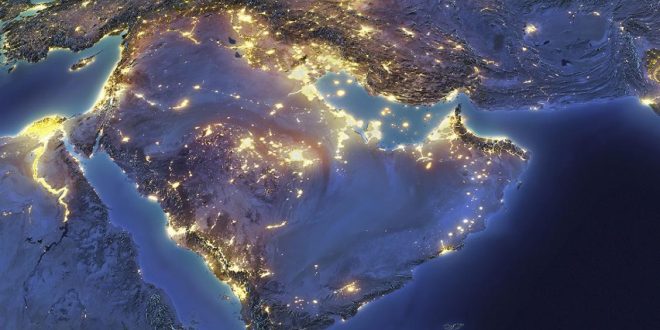
Iran has targeted, and, in some cases, struck, major Gulf energy infrastructure. Qatar stands out as the most significant example, as it accounts for roughly 20 percent of global liquefied natural gas (LNG) exports, almost all of which are concentrated in and around the Ras Laffan hub, the world’s LNG production and export facility.
The Iranian hit on Ras Laffan on 18 March is the singular largest ever on any LNG facility. The attack was a direct response to Israel’s attack on the South Pars gas field. QatarEnergy has already declared force majeure on contracted shipments to Italy, Belgium, South Korea, and China.
Iran has also issued warnings or evacuation notices for facilities in several Gulf countries, including Saudi Arabia’s SAMREF refinery and Jubail petrochemical complex, and the UAE’s Al Hosn gas field.
“Oil fields, refineries, pipelines, ports, and shipping lanes become military targets precisely because hydrocarbons are so central to state finance and global trade,” Kaboub explained.
Describing them as instruments of geopolitical power, he explained that fossil fuels are not just military targets of the two parties involved in the conflict, but are also weaponized to drag third parties either directly into the conflict, like the Arab Gulf states, or indirectly via financing and logistical support, like the UK and EU, because they fear the economic ripple effects on their own countries.”
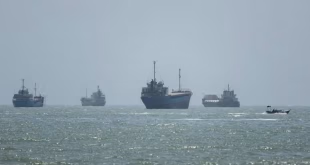
Iran blocked traffic through the Strait of Hormuz, creating a chokepoint through which over 20 million barrels per day—roughly one-fifth of global oil—flows. On Tuesday, 24 March, it threatened to do the same with the Bab el-Mandeb, effectively disrupting another critical global shipping route.
The war has caused “the biggest oil supply disruption in history,” according to an analysis by consulting firm Rapidan Energy. Oil prices reached almost $120 per barrel. Iran warned oil prices could reach $200 a barrel as the war in the region continues.
“The current disruption around the Strait of Hormuz is a reminder that fossil fuel dependence turns regional conflict into a global economic shock,” Kaboub said. This includes cascading effects across supply chains, contributing to inflation in fuels, shipping, fertilizers, animal feed, food items, and manufactured goods reliant on petrochemicals, including high-tech products and military equipment.
That same day, Tehran began seeking to collect unofficial tolls of up to $2 million per commercial vessel passing through the narrow waterway it controls. Meanwhile, Trump sought to take control of Kharg Island, Iran’s key oil export terminal.
“The current disruption around the Strait of Hormuz is a reminder that fossil fuel dependence turns regional conflict into a global economic shock.”
After Trump’s threats to “obliterate” Iran’s energy grid, Iran’s Islamic Revolutionary Guard Corps (IRGC) said any strike on Iran’s energy facilities or ports would trigger a “crushing and devastating response,” warning that in such a scenario, oil and gas infrastructure across the region linked to the United States and its Western allies would be “set on fire and destroyed.”
“[M]ilitary strategy in the Middle East has often focused on control of pipelines, export terminals, and strategic chokepoints,” energy strategist and senior visiting fellow at George Mason University, Umud Shokri, told Raseef22.
Some studies estimate that 25 to 50 percent of interstate conflicts since 1973 have had oil-related dimensions. In the Middle East, examples include Iraq’s 1990 invasion of Kuwait, which involved oil-related grievances alongside broader political motivations, and the 1953 coup in Iran, linked in part to the nationalization of oil assets.
The Carter Doctrine also demonstrated how energy security shaped U.S. strategic commitments to protect Persian Gulf oil flows. Established in 1980, the doctrine codified the US resolve to secure oil in the Gulf, declaring that any external attempt to control the Persian Gulf would be met with force. US naval protection of the Strait of Hormuz during the Iran–Iraq War, and since, culminated in the 1991 Gulf War, when US forces defended Saudi oil infrastructure as Riyadh provided funding and fuel.
“In most cases, the objective has been less about capturing oil fields outright and more about preventing adversaries from gaining leverage over the global supply,” Shokri said.
A loss for the Middle East, a win for other fossil fuel producers
Beyond their environmental and health effects, attacks on major fossil fuel infrastructure and oil tankers are making companies in the Global North richer.
The main beneficiaries of the current volatility are oil and gas producers located outside the immediate conflict zone, according to Shokri. In particular, US shale producers and major international companies such as ExxonMobil and Chevron stand to benefit from rising crude prices. At the same time, LNG exporters, including firms like Cheniere Energy, gain from increased global demand for alternative supplies, he added.
“American energy dominance is back under President Trump,” reads a White House statement published on 24 February.
Some analysts estimate that US LNG exports alone could generate up to $4 billion in windfall profits. At the same time, the US is set to open its first new oil refinery in nearly 50 years.
US shale producers and major international companies such as ExxonMobil and Chevron stand to benefit from rising crude prices, while LNG exporters, including firms like Cheniere Energy, gain from increased global demand for alternative supplies.
Trump himself argued that the US benefits when oil prices go up. “The United States is the largest Oil Producer in the World, by far, so when oil prices go up, we make a lot of money,” the US President said.
Facing pressure to contain rising oil prices, Washington introduced a 30-day sanction waiver permitting the sale of approximately 128 million barrels of Russian crude that had been stranded at sea. Before the war on Iran, Russia’s oil revenues stood at around $135 million per day. Those earnings have since surged to roughly $270 million daily, significantly strengthening Moscow’s capacity to finance its ongoing war in Ukraine through expanded energy profits.
Oil companies in the EU are making €81.4 million in extra profits every day from skyrocketing fuel prices since the start of the war, or around €2.5 billion in additional profits for March alone, according to one study.
At the same time, prices around the region have surged, affecting transportation and food prices. In Egypt, higher oil and gas import costs pushed the government to cut electricity use, raise fuel prices, and impose emergency savings measures, with reports of early food price increases and warnings that fertilizer disruptions could trigger a broader wave of inflation if the conflict drags on.
Since the beginning of its aggression on Iran with the US, on February 28, Israel halted its gas exports to Egypt and Jordan.
About 60 percent of Egypt’s total gas imports come from Israel, with which Cairo signed a Peace Treaty in 1979. Gas imports commenced in 2020. Due to the shortage and war constraints, it was forced to reduce energy consumption, imposing an evening curfew on shops, malls, and restaurants to conserve electricity. As a result, the country’s monthly energy import bill rose from $560 million to $1.65 billion.
Jordan, where 60 percent of energy consumption depends on Israel, activated an emergency plan, including using gas stocks, importing LNG, and burning more diesel, while industrial users faced higher input costs. By mid March, the government had spent $210 million to import extra diesel and fuel oil.
Reshuffling power through renewable energy
If oil has defined the geopolitical architecture of conflict in the Middle East, the question is whether renewable energy can fundamentally reshape it.
“If the world had already transitioned heavily to renewable energy, the global impact of the current Middle East conflict would be far smaller. Oil price spikes, threats to close the Strait of Hormuz, and attacks on refineries or LNG facilities would no longer trigger major global economic shocks,” said Shokri.
Kaboub agrees. He pointed out that the region has the capacity to operate entirely on renewable energy, and had that been the case, the region’s economic structure would be more diversified. What is at stake is not simply a change in energy sources, but a transformation in how power is distributed across the global economy.
“If the world had already transitioned heavily to renewable energy, the global impact of the current Middle East conflict would be far smaller.”
“A world less dependent on oil would be less vulnerable to the weaponization of tanker routes, refinery disruptions, and sudden fuel-price shocks,” Kaboub said, adding that “a renewables-based system does not make peace automatic, but it does make energy blackmail much harder.”
Amid the energy crisis triggered by the war in the region, Spain and Pakistan have benefited from their earlier investments in solar power, which have helped cushion them from volatile fossil-fuel prices and supply shocks.
Unlike oil, renewable energy is not concentrated in a handful of territories or chokepoints. It can be produced domestically, at scale, and without reliance on global shipping lanes that can be blocked or militarized.
Domestically generated renewable energy cannot be sanctioned, blockaded, or tied to foreign currency pricing. As Kaboub argues, that is the kind of economic independence renewable energy sovereignty can deliver. This is the core shift: from dependence on external supply chains to the possibility of energy sovereignty.
In that sense, “Climate change increasingly functions as a security issue because it affects food systems, water access, livelihoods, and displacement,” Safa’ Al Jayoussi, Global Climate Lead at Oxfam Climate Initiative (OCI), told Raseef22.
The World Bank estimates climate impacts could lead to up to 216 million people becoming internally displaced by 2050. Kaboub reinforces this broader framing, arguing that renewable energy is not only about emissions reduction, but also about reducing foreign-exchange pressure, insulating economies from imported inflation, and escaping the geopolitical volatility built into fossil fuel markets.
“Climate policy should be understood as industrial policy, development policy, and security policy all at once,” he added.
However, the transition to renewables is not inherently just. The transition itself is already unfolding within the same unequal structures that defined the fossil fuel era. Around 70 percent of these minerals are located in the Global South, yet most profits remain concentrated in wealthier economies.
As Al Jayousi argues, the global race for minerals essential to renewable technologies risks replicating the same extractive dynamics seen in fossil fuel economies, rooted not just in the fuels themselves but in unequal and often militarized systems.
Without a just and equitable energy transition, this shift could simply replace one extractive model with another. This dynamic is evident in the extraction of lithium, cobalt, nickel, and rare earth elements, as well as large-scale renewable projects that can involve land dispossession, environmental degradation, and limited community consent, creating new “sacrifice zones.”
Al Jayousi warns that the transition to renewable energy is increasingly being controlled by wealthy polluters, reproducing colonial patterns that deepen inequality and contribute to human rights violations.
This imbalance is visible not only in resource extraction but in global investment patterns. In 2024, high-income countries accounted for roughly half of clean energy investment, while regions such as Africa and the Middle East received only marginal shares, despite vast energy needs. Climate finance remains far below what is needed, leaving many countries to face rising heat, drought, and energy insecurity with limited support. This funding gap means that even where solar and other clean technologies are expanding, governments often lack the upfront capital to scale them quickly and fairly.
Renewable energy technologies are already mature, scalable, and increasingly cost-competitive, with renewable electricity in many cases now cheaper to produce than fossil-fuel power.
Meanwhile, the MENA region possesses some of the world’s highest solar and wind potential, alongside the resources needed for a green industrial transformation.
The region is experiencing an unprecedented acceleration in clean energy projects, with operational renewable capacity reaching 43.7 gigawatt (GW) as of 2025, according to Dii’s MENA Energy Outlook 2026 report. The total project pipeline has surged to 202 GW, with 38 GW already under construction, significantly narrowing the gap to meeting the region’s aggregate 2030 national ambitions.
Renewable energy technologies are already mature, scalable, and increasingly cost-competitive, with renewable electricity in many cases now cheaper to produce than fossil-fuel power. Lebanon provides a strong example of decentralized renewable energy because rooftop solar spread quickly when the grid failed to provide reliable power.
“You can’t blow up the sun,” argues Greenpeace MENA.
According to Kaboub, transformative climate finance could enable countries to achieve energy independence, economic resilience, and even escape cycles of debt, outcomes that may be seen as a threat to existing global hierarchies. As a result, he argues that continued dependence on fossil fuels is often strategically maintained, limiting the potential for genuine, self-sustaining development.
“Avoiding this requires stronger governance, fair supply chains, and meaningful community participation,” Al Jayousi said. CEDARE and other organizations are calling for a just, decentralized renewable transformation for a more energy sovereign region. But a just transition must be a deconolized transition, argues Kaboub, or else one dependency would merely be replaced by another.
In an interview with Jake Sullivan, former US National Security Advisor who brokered the Iran deal negotiations during the Obama administration, American TV host John Stewart labeled US ambitions as “imperialistic.” Seen in this light, maintaining the policy around oil and energy is not an outlier, but part of a broader logic of control in Global South regions.
https://raseef22.net/article/1101918-war-oil-and-a-middle-eastern-renewable-energy-transition

![Numerous merchant ships belonging to Iran and other countries remain at anchor in the Strait of Hormuz in Bandar Abbas, Iran, on September 10, 2026. [Fatemeh Bahrami – Anadolu Agency]](https://uskenergy.com/wp-content/uploads/2026/10/Hormuz-310x165.webp)