Iranian Parliament Speaker Mohammad-Bagher Ghalibaf’s rising influence increasingly reflects a Bonapartist adaptation towards centralised authority exercised by an insider promising order without structural reform
The concept of “Ghalibaf and Bonapartism” has emerged as a useful analytical lens for understanding the Islamic Republic’s evolving power structure amid mounting domestic and international pressure. Rooted in Karl Marx’s analysis of Louis Napoleon’s 1851 coup in The Eighteenth Brumaire of Louis Bonaparte, Bonapartism describes a political configuration in which a strongman, backed by the military and state apparatus, rises above factional conflict to impose order. This figure functions as an arbiter among competing elites, consolidating authority while preserving the underlying structure of power. Rather than transforming the system, Bonapartism stabilises it through centralisation, coercive capacity, and claims of technocratic efficiency during periods of systemic crisis.
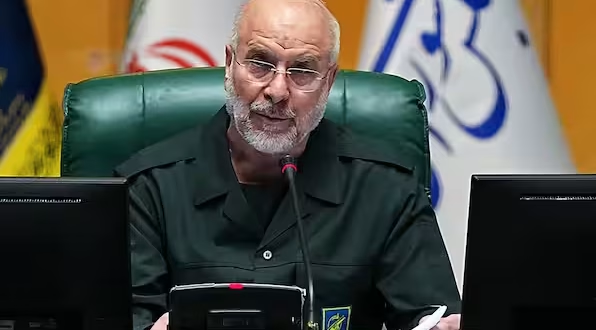
In contemporary Iran, Parliament Speaker Mohammad-Bagher Ghalibaf, former Islamic Revolutionary Guard Corps (IRGC) commander, Tehran mayor, and long-time presidential contender, aligns with key elements of this model. His combination of security credentials and administrative experience places him at the intersection of coercion and governance. As the Islamic Republic faces economic strain, political fragmentation, and renewed external pressure, figures capable of bridging institutional divides have gained prominence. Within this context, Ghalibaf’s role increasingly reflects a Bonapartist adaptation: a move toward centralised authority exercised by an insider promising order without structural reform.
Ghalibaf’s Trajectory: From Security Apparatus to Political Centre
Ghalibaf’s career reflects the convergence of military, economic, and political influence that characterises potential Bonapartist figures. Born in 1961, he rose through the IRGC during the Iran–Iraq War and later commanded the IRGC Aerospace Force (1997–2000), appointed directly by Supreme Leader Ali Khamenei. This signalled early trust within the regime’s inner circle.
Ghalibaf’s Trajectory: From Security Apparatus to Political Centre
Ghalibaf’s career reflects the convergence of military, economic, and political influence that characterises potential Bonapartist figures. Born in 1961, he rose through the IRGC during the Iran–Iraq War and later commanded the IRGC Aerospace Force (1997–2000), appointed directly by Supreme Leader Ali Khamenei. This signalled early trust within the regime’s inner circle.
He later led the IRGC-affiliated Khatam al-Anbia construction conglomerate before becoming national police chief (2000–2005) and then Tehran’s mayor (2005–2017). His mayoral tenure strengthened his technocratic image, marked by large infrastructure projects but also corruption allegations related to land transfers and municipal finance.As Speaker of the Majlis since 2020, re-elected in 2024, Ghalibaf has consolidated influence across factions, maintaining IRGC ties while navigating conservative political blocs. This balancing ability positions him as a key mediator within a fragmented elite landscape.
War, Economic Strain, and the Reconfiguration of Authority
Iran’s political system, structured around the Supreme Leader’s authority alongside elected bodies and powerful security institutions, has faced growing strain due to economic decline, social unrest, and external conflict. Inflation, currency depreciation, and recurring protests since 2018 have reflected broad dissatisfaction with governance and living standards.
The recent Iran-Israel war and the ceasefire reached in early April marked a critical turning point. While the ceasefire halted direct military confrontation, it did not resolve underlying tensions or reduce internal pressure on Iran’s political system. The conflict intensified scrutiny of Iran’s security and political leadership and deepened elite competition over strategic direction.
At the same time, indirect negotiations between the United States and Iran reportedly taking place through intermediaries and regional channels, including talks facilitated in Pakistan, have become a key diplomatic track. Within this context, Mohammad-Bagher Ghalibaf’s reported role in back-channel engagement and crisis coordination has elevated his position within the political system. His standing as both a senior political figure and a veteran of the security establishment positions him as a key intermediary in managing the transition from military confrontation toward controlled de-escalation.
These developments have increased the demand for centralised coordination and crisis management. Ghalibaf’s experience across the military, administrative, and legislative spheres enables him to operate at the intersection of security policy and political negotiation, reinforcing his relevance in this period of hybrid conflict and diplomacy.
Centralisation and Elite Arbitration
In the aftermath of the Iran–Israel war and the early-April ceasefire, Ghalibaf has increasingly positioned himself as a central mediator within Iran’s political system. His coordination with senior figures such as Ali Shamkhani to streamline security and diplomatic decision-making reflects a growing trend toward centralised authority and tighter crisis management. This centralisation has become more pronounced as the political system adjusts to the dual pressures of military confrontation and diplomatic engagement.
Ghalibaf’s political posture combines a hardline approach to domestic dissent with an emphasis on technocratic governance. He has framed social unrest primarily as a security challenge while simultaneously presenting himself as an administrator capable of restoring state functionality. In the context of the ceasefire and renewed diplomatic activity, this dual role, balancing coercive authority with managerial competence, underscores the Bonapartist dynamic. Importantly, this shift does not represent a structural break with the Islamic Republic’s institutional framework. Instead, it reflects an attempt to stabilise the existing order by consolidating authority within a trusted insider during a period of geopolitical and internal uncertainty.
The Western Paradox: Strategic Engagement with an Insider
Ghalibaf’s rising influence has drawn increasing attention from abroad, particularly following the escalation and subsequent ceasefire. Public statements by US officials referencing communication with a “respected” Iranian figure have been widely interpreted as alluding to Ghalibaf. This aligns with reports of indirect U.S.–Iran engagement occurring through intermediaries, including diplomatic channels involving Pakistan.
Such engagement reflects a persistent strategic dilemma. While Ghalibaf remains closely tied to Iran’s security establishment and its coercive apparatus, his embedded position within the state makes him a potentially effective interlocutor during periods of controlled de-escalation. This has opened space for limited, transactional diplomacy aimed at managing immediate tensions rather than pursuing comprehensive normalisation. However, this approach carries inherent risks. Engagement with a central insider may inadvertently reinforce existing power structures, while overestimating the influence of any single actor risks misreading the complexity of Iran’s political landscape.
Stability Without Reform: The Limits of a Bonapartist Outcome
Analysts such as Saeed Laylaz argue that systemic pressures ranging from economic dysfunction to elite fragmentation are pushing the political system toward greater centralisation. In this scenario, authority consolidates not as part of democratic reform but as a mechanism for restoring operational coherence amid prolonged crisis. While such consolidation may enhance short-term coordination and facilitate tactical diplomacy following the ceasefire, it also risks entrenching authoritarian patterns of governance. The comparison to post-Soviet centralisation remains relevant: stability achieved through securitisation rather than political liberalisation.
Conclusion
“Ghalibaf and Bonapartism” captures a structural trajectory within the Islamic Republic rather than a purely personal political project. The state remains resilient yet constrained, capable of absorbing shocks without undertaking deep institutional reform. The ceasefire and renewed diplomatic engagement have not diminished this dynamic; instead, they have accelerated the consolidation of authority around figures positioned to manage crisis without altering the foundations of the system.
Whether Ghalibaf fully consolidates such a role will depend on the durability of the ceasefire, the trajectory of US–Iran engagement, intra-elite cohesion, and domestic tolerance for centralised governance. His ascent underscores how conflict and partial de-escalation can reshape authority while leaving the underlying political architecture largely intact.

![Numerous merchant ships belonging to Iran and other countries remain at anchor in the Strait of Hormuz in Bandar Abbas, Iran, on September 10, 2026. [Fatemeh Bahrami – Anadolu Agency]](https://uskenergy.com/wp-content/uploads/2026/10/Hormuz-310x165.webp)