For India, the challenge will be to pursue connectivity ambitions while carefully managing the geopolitical risks associated with a volatile West Asia
The India-Middle East-Europe Economic Corridor (IMEC), announced during the G20 summit in New Delhi in September 2023, is one of the most ambitious connectivity initiatives linking Asia, West Asia and Europe. The project aims to establish an integrated network of shipping routes, railways, energy infrastructure, and digital connectivity linking India to Europe through the Gulf and Israel. India, the United States, Saudi Arabia, the United Arab Emirates (UAE), France, Germany, Italy and the European Union signed the initial memorandum of understanding, positioning the initiative as a major new framework for economic cooperation across three continents.
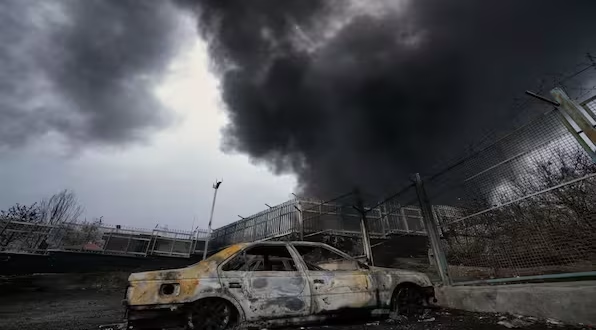
For India and its partners, IMEC is more than a trade corridor. It reflects a strategic effort to diversify global supply chains, strengthen economic integration between Asia and Europe, and offer a potential alternative to China’s Belt and Road Initiative (BRI). Yet the corridor’s viability depends heavily on regional stability in West Asia. Escalating tensions between Iran and Israel, and the possibility of a direct military confrontation between the two rivals, could significantly reshape the geopolitical environment in which the project must operate. A prolonged Iran-Israel conflict would not only threaten the physical infrastructure envisioned under IMEC but could also force India to reassess the risks associated with its connectivity ambitions and energy interests across West Asia.
IMEC’s Strategic Vision
IMEC is designed as a multimodal connectivity corridor linking India to Europe through a combination of maritime shipping and rail transport. The proposed route connects Indian ports to the Gulf via sea lanes, followed by rail links through the UAE and Saudi Arabia, and then onward through Jordan and Israel to Mediterranean ports serving European markets. Beyond transportation, the initiative also includes plans for energy pipelines, electricity transmission networks, and fibre-optic cables aimed at strengthening clean-energy trade and digital connectivity between participating economies. By integrating these sectors, IMEC seeks to enhance economic cooperation across the Indo-Mediterranean region while improving supply-chain resilience.
Strategically, the corridor has broader geopolitical significance. Analysts argue that IMEC could reinforce “rules-based connectivity” across Eurasia while offering an alternative to infrastructure networks dominated by a single power, particularly China’s BRI. In this sense, the corridor reflects a wider geopolitical shift in which infrastructure and trade routes are increasingly intertwined with strategic competition among major powers. Yet the project’s route also exposes its vulnerabilities. IMEC deliberately bypasses Iran and instead relies on infrastructure in Gulf states and Israel, placing it directly within one of the most volatile geopolitical regions in the world.
Regional Conflict and Strategic Vulnerabilities
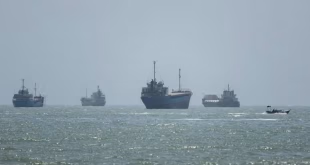
West Asia has long been a region where infrastructure, energy flows, and geopolitical rivalries intersect. The rivalry between Iran and Israel represents one of the region’s most persistent and volatile fault lines. For years, the two countries have engaged in a shadow conflict involving cyberattacks, covert operations, and proxy warfare across Lebanon, Syria, and Iraq. A direct military confrontation between the two powers would have significant implications for regional stability and global trade routes. Much of the world’s energy supply passes through the Persian Gulf, particularly the Strait of Hormuz, a strategic maritime chokepoint linking Gulf oil producers to international markets.
Disruptions to shipping routes or energy infrastructure in the Gulf could rapidly ripple through global markets, raising transportation costs and increasing risks for investors. Even limited instability in the region can affect maritime insurance rates, shipping schedules, and supply-chain reliability, all of which are essential for the viability of a large infrastructure initiative such as IMEC. Escalating geopolitical tensions in the region have already demonstrated the vulnerability of maritime trade routes. Attacks on shipping in the Red Sea and disruptions linked to regional conflicts have highlighted how quickly geopolitical crises can affect global commerce and connectivity projects.
How Conflict Could Disrupt the Corridor
An Iran-Israel war could affect IMEC in several ways.
First, the corridor relies on key logistical nodes in Israel, particularly Mediterranean ports that would connect Gulf rail networks to European shipping routes. In the event of war, Israeli infrastructure could become a potential target for missile or drone attacks, disrupting trade flows and delaying corridor development.
Second, Gulf infrastructure could also face heightened security risks. Ports in the UAE and Saudi Arabia are expected to serve as critical nodes in the corridor’s logistics network. If regional tensions escalate, these facilities could face security threats from missile strikes, drone attacks, or maritime disruptions linked to proxy conflicts.
Third, regional maritime routes could become increasingly unstable. Shipping lanes across the Persian Gulf, the Red Sea, and the Eastern Mediterranean are central to the corridor’s transport model. Any sustained conflict could raise insurance costs, deter investment, and increase the economic risks associated with building large-scale infrastructure across the region.
Finally, energy security remains a critical concern. India imports a significant portion of its crude oil from Gulf producers such as Saudi Arabia, Iraq, and the UAE. Any disruption to regional energy exports would therefore have immediate economic consequences for India, including higher fuel costs and inflationary pressure.
Iran’s Strategic Response
From Tehran’s perspective, IMEC is not simply an economic initiative but also a geopolitical project that bypasses Iran and potentially reduces its role in regional connectivity networks. Iran has long promoted alternative infrastructure routes, most notably the International North-South Transport Corridor (INSTC), which links India with Russia and Europe through Iranian territory and the Caspian region. By strengthening the INSTC in cooperation with Russia and Central Asian states, Tehran could attempt to position itself as a key transit hub connecting Eurasian markets.
Iran could also pursue asymmetric strategies aimed at raising the economic costs of competing projects. Support for regional proxy groups or disruptions to maritime trade routes could create uncertainty for investors and slow the implementation of infrastructure projects that exclude Iranian territory. At the same time, Tehran may deepen economic coordination with China and other emerging economies seeking alternatives to Western-backed connectivity initiatives.
India’s Strategic Balancing Act
For India, the evolving geopolitical landscape presents a complex diplomatic challenge.
Over the past decade, New Delhi has significantly strengthened relations with Israel and Gulf states while maintaining historical ties with Iran. Israel has emerged as an important partner in defence technology and security cooperation, while Gulf countries remain central to India’s energy security and host a large Indian diaspora. At the same time, Iran remains strategically relevant through projects such as the Chabahar port and the International North–South Transport Corridor. These initiatives provide India with access to Central Asia and Eurasian markets while reducing reliance on Pakistan-based transit routes.
The prospect of an Iran-Israel conflict therefore places India in a delicate position. Aligning too closely with one side could complicate relations with other key partners across the region. As a result, India has generally pursued a policy of strategic balance. New Delhi continues to advocate diplomatic dialogue and regional stability while simultaneously expanding economic partnerships across West Asia.
India is also pursuing diversification strategies to reduce vulnerability to geopolitical disruptions. These include expanding renewable energy capacity, strengthening strategic petroleum reserves, and developing multiple connectivity routes linking Asia with Europe. In this context, IMEC is likely to remain an important component of India’s connectivity strategy. However, policymakers may increasingly view it as one element within a broader network of trade corridors rather than a single transformative project
The Future of IMEC in an Uncertain Region
The promise of IMEC lies in its potential to reshape trade routes between Asia, West Asia and Europe while strengthening economic integration across the Indo-Mediterranean region. Yet the corridor’s success ultimately depends on a stable geopolitical environment. A prolonged Iran-Israel conflict would expose the fragility of this assumption. Rising security risks, disruptions to shipping routes, and regional polarisation could delay the project’s implementation and weaken investor confidence.
For India, the challenge will be to pursue connectivity ambitions while carefully managing the geopolitical risks associated with a volatile West Asia. New Delhi’s ability to maintain strategic flexibility, diversify trade routes, and balance partnerships across the region will ultimately determine whether initiatives like IMEC can move forward despite growing geopolitical turbulence.

![Numerous merchant ships belonging to Iran and other countries remain at anchor in the Strait of Hormuz in Bandar Abbas, Iran, on September 10, 2026. [Fatemeh Bahrami – Anadolu Agency]](https://uskenergy.com/wp-content/uploads/2026/10/Hormuz-310x165.webp)