Global energy security depends not only on whether ships can pass through Hormuz, but whether they can do so freely, predictably, and without paying tribute disguised as environmental stewardship
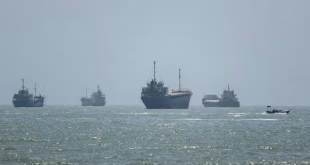
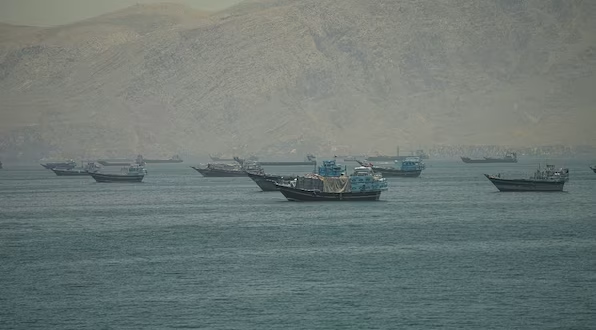
The Strait of Hormuz is one of the world’s most important energy chokepoints, with about 20 million barrels of oil passing through it each day in 2024, nearly 20 per cent of global petroleum liquids consumption. A US-Iran memorandum of understanding (MoU) and the reopening of Hormuz would be welcomed by energy markets because they could lower geopolitical risk, ease pressure on crude and LNG flows, and help restore confidence in shipping.
However, reopening the strait does not mean the risk has disappeared. Tehran and the IRGC could simply move from open disruption to a more subtle form of pressure by presenting new charges as “fees”, “service charges”, “environmental payments”, or even a so-called “carbon tax”. This would not be real environmental policy. It would be a way to disguise strategic extortion, turn Iranian leverage over Hormuz into something routine, and test how strongly the United States, Gulf states, shipping companies, and energy markets are willing to push back.
Iran has long used Hormuz as a tool of asymmetric pressure, threatening closure and relying on IRGC Navy tactics such as vessel seizures, harassment, and unsafe manoeuvres to raise the cost of confrontation. During the recent crisis, this pattern reportedly shifted towards a more formalised model, with Iranian officials discussing keeping Hormuz open under new conditions, including transit fees set with Oman. This matters because a direct closure invites military pressure and wider escalation, while a fee regime is harder to challenge. Tehran could claim vessels are still moving and that charges are tied to navigation, safety, or environmental protection. The coercion would remain, but the packaging would look more legal and bureaucratic.
Rebranding Tactics in the Post-MoU Era
Iranian messaging already suggests this shift. By presenting future charges as “transit fees”, “maritime service fees”, or environmental payments, Tehran could move the debate away from extortion and towards regulation. This would be a useful political strategy. It would allow Iran to monetise its geography while claiming that it is acting as a responsible coastal state.
A so-called environmental fee would be especially attractive. The Persian Gulf faces real environmental pressures, including oil pollution, dense tanker traffic, industrial activity, and military operations. Iran could exploit these genuine concerns to justify charges on vessels transiting Hormuz. By invoking climate language or carbon pricing, Tehran could present itself as protecting the Gulf’s ecosystem while extracting rents from the same energy flows it has previously threatened.
This framing would also exploit legal ambiguity. Under the United Nations Convention on the Law of the Sea, straits used for international navigation are governed by transit passage. Coastal states may adopt certain rules related to safety and pollution prevention, but they cannot arbitrarily impede transit passage or turn an international chokepoint into a toll road (UNCLOS, Part III). Iran may try to blur that distinction by presenting charges as environmental governance rather than strategic coercion.
Not Environmental Policy: Strategic Extortion
The problem is not environmental protection itself. The Gulf needs stronger environmental governance. The issue is who controls the mechanism, how fees are imposed, where revenues go, and whether passage remains free from coercion. A legitimate environmental framework would be transparent, multilateral, independently monitored, and consistent with international maritime law. It would involve institutions such as the International Maritime Organisation, clear pollution standards, audited funds, and non-discriminatory treatment of vessels. It would not be enforced through opaque payment channels, IRGC-controlled corridors, selective exemptions, or politically conditioned access.
The strategic purpose of such a policy would be clear. First, it would generate revenue at a time when Iran faces economic pressure from sanctions, war damage, and fiscal stress. Second, it would normalise Iran’s role as a gatekeeper over Hormuz. If shipping firms begin to treat such payments as a routine operating cost, Tehran would gain leverage without needing to close the strait. Third, it would raise costs across energy markets. Even modest fees could increase freight rates, insurance premiums, and risk pricing. Most importantly, it would test international tolerance. If Washington, Gulf exporters, Asian importers, and insurers quietly accept rebranded charges, Iran may conclude that limited coercion is acceptable if it is bureaucratised.
Global Implications
For the United States, the danger is that a diplomatic opening could unintentionally legitimise Iranian leverage over a global common. Washington may prioritise de-escalation, nuclear talks, and lower oil prices, but accepting disguised coercion would weaken freedom of navigation, a core US strategic interest. For Gulf states, the risks are direct. Saudi Arabia, the UAE, Kuwait, Iraq, and Qatar depend heavily on secure maritime access. Some have invested in bypass pipelines, but these routes cannot fully replace Hormuz. A fee-based coercion system would leave Gulf exporters exposed to Iranian pressure even after the strait formally reopens.
Shipping firms and insurers would face a practical dilemma: pay and preserve cargo movement, or resist and risk delays, higher insurance costs, or confrontation. This is where bureaucratised coercion becomes dangerous. Coercion does not always look like a blockade. Sometimes it looks like clearance forms, service fees, environmental documentation, inspection rules, or “voluntary” payments.
The India Factor
For India, the implications would be especially important. India is one of the world’s largest crude oil importers and remains highly exposed to Gulf energy flows. A US-Iran deal and the reopening of Hormuz would initially benefit New Delhi by easing crude prices, reducing pressure on the oil import bill, helping contain inflation, and supporting energy supply stability. Reuters has reported that early signs of a US-Iran deal and Hormuz reopening were expected to reduce India’s import costs.
However, if Iran later rebrands maritime coercion as environmental fees, service charges, or carbon-related levies, India could face a more complicated challenge. Even modest charges on tankers could raise shipping, insurance, and refining costs. More importantly, uncertainty over Hormuz access would keep a risk premium in oil markets, limiting the full benefit of lower geopolitical tension.
New Delhi may prefer uninterrupted supply and could be tempted to treat such charges as a manageable cost of energy security. But quiet acceptance would risk normalising Iranian leverage over a chokepoint central to India’s economy. For India, the question is not only whether oil prices fall after Hormuz reopens. The larger issue is whether Hormuz remains open, predictable, and free from politicised extraction.
Market Consequences
A reopened Hormuz may reduce immediate pressure on oil prices, but full normalisation will not be automatic. Reuters has reported that Middle East oil and gas output could take months, and possibly longer, to fully recover after the disruption. Producers must restart operations, clear tanker backlogs, rebuild confidence among insurers and shippers, and assess infrastructure damage. A fee-based system would keep market risk alive even after physical flows resume. Traders would price not only barrels and shipping time, but also political uncertainty over access. Gulf exporters would face a new layer of vulnerability. Asian importers would confront higher costs and more complex supply planning. Even limited Iranian fees could therefore affect global market psychology.
Conclusion
The potential US-Iran deal and the reopening of the Strait of Hormuz may be necessary steps towards de-escalation. They could ease oil prices, reduce pressure on energy importers, and stabilise Gulf export flows. But reopening the strait is not enough if the terms of access are gradually rewritten by Tehran and enforced, directly or indirectly, by the IRGC. The central issue is not whether Iran uses the language of environmental protection, maritime safety, or carbon pricing. The issue is whether such charges restrict passage, extract rents under pressure, privilege politically acceptable vessels, or strengthen Iranian control over maritime traffic. If they do, they are not environmental policy. They are coercion by another name.
For India and other energy-importing states, the stakes are both immediate and structural. A stable Hormuz can lower crude prices, ease inflationary pressure, and strengthen supply security. But a Hormuz reopened under Iranian-controlled fee structures would create a new dependency. India should support diplomatic efforts that keep the strait open while resisting arrangements that institutionalise coercive payments.
The international response should be clear: environmental protection in the Gulf is legitimate, but it must be transparent, multilateral, and consistent with international law. It cannot become a cover for strategic extortion. Without clear rules, monitoring, and enforcement, Iran could transform a temporary crisis into a permanent revenue and leverage mechanism. Global energy security depends not only on whether ships can pass through Hormuz, but whether they can do so freely, predictably, and without paying tribute disguised as environmental stewardship.

![Numerous merchant ships belonging to Iran and other countries remain at anchor in the Strait of Hormuz in Bandar Abbas, Iran, on September 10, 2026. [Fatemeh Bahrami – Anadolu Agency]](https://uskenergy.com/wp-content/uploads/2026/10/Hormuz-310x165.webp)