What once looked like diversification for both now feels like necessity. The relationship is no longer just about barrels moving from one port to another; it is increasingly about managing shared risks, building joint infrastructure, and aligning long-term strategies
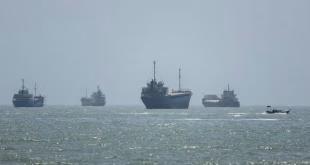
The Iran-Israel war of 2026 has not only disrupted global energy markets but also accelerated a structural shift in India-Saudi Arabia energy relations. What was once a largely transactional oil trade is evolving into a broader strategic partnership centred on supply security, downstream integration, and emerging clean-energy collaboration. This transformation, already underway through bilateral agreements between 2023 and 2025, gained urgency after the temporary closure of the Strait of Hormuz in early March 2026, which disrupted roughly 20 per cent of global oil flows and exposed the fragility of chokepoint-dependent supply systems.
Historically, the relationship was straightforward. Saudi Arabia consistently ranks among India’s top crude suppliers, accounting for around 13-18 per cent of imports. India, which imports over 85 per cent of its crude, depended heavily on Gulf producers, with a large share of shipments transiting Hormuz. This arrangement was efficient in stable conditions. Saudi Arabia secured a large, growing Asian market, while India benefited from reliable and competitively priced supplies. Yet this model carried inherent risks. It tied both countries to a single maritime corridor and limited the depth of their engagement beyond oil trade.
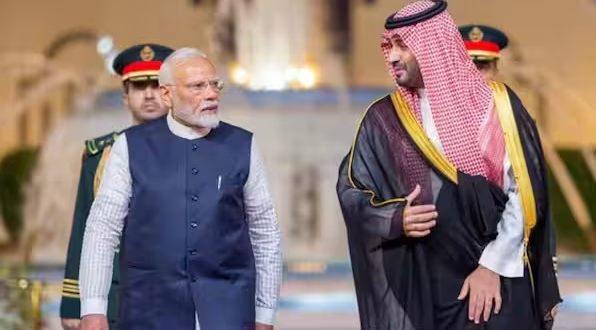
Recognising these constraints, both sides began expanding cooperation well before the conflict. The 2006 Delhi Declaration and the 2010 Riyadh Declaration framed energy ties in strategic terms. This evolved further under Saudi Arabia’s Vision 2030 and India’s energy diversification strategy. A key milestone came in September 2023, when the two countries signed a memorandum of understanding focused on green hydrogen, electricity interconnection, and renewable supply chains. Prime Minister Narendra Modi’s 2025 visit to Saudi Arabia reinforced this trajectory, with agreements on joint refining projects, petrochemical investments, and collaboration across clean-energy technologies. These steps signalled a move toward integration, but their full significance became clear only after the events of 2026.
The closure of Hormuz marked a turning point. Oil prices surged above $120 per barrel, LNG markets tightened, and supply chains across Asia came under severe strain. For India, the impact was immediate and severe. Nearly half of its crude imports normally pass through the strait, and even with strategic reserves, refiners faced bottlenecks, rising costs, and logistical challenges. The crisis demonstrated that supplier diversification alone cannot mitigate risk if transport routes remain concentrated.
Saudi Arabia’s response highlighted its evolving role. By utilising the East–West pipeline to reroute crude to the Red Sea and expanding export capacity through Yanbu, Riyadh managed to bypass Hormuz for a portion of its shipments. While this capacity could not fully replace Gulf flows, it provided a critical alternative at a time when other suppliers struggled to meet demand. For India, this reinforced Saudi Arabia’s position not just as a supplier but as a partner capable of delivering under stress.
This shift is now visible in concrete areas of cooperation. Joint refining projects in India linked to earlier agreements have taken on new strategic importance. By processing Saudi crude within India, these projects reduce exposure to maritime disruptions and ensure a more stable supply of refined products. They also align with Saudi Arabia’s goal of moving downstream and capturing greater value across the energy chain. Instead of a simple export relationship, the two countries are building shared infrastructure that ties their energy systems more closely together.
Clean energy has emerged as another pillar of this partnership. The green hydrogen agenda, outlined in the 2023 agreement, now serves both countries’ strategic interests. India aims to produce 5 million tonnes of green hydrogen annually by 2030, while Saudi Arabia is investing heavily in large-scale projects such as NEOM to position itself as a global exporter. Collaboration in hydrogen production, storage, and transport allows both countries to hedge against fossil fuel volatility while advancing their long-term transition goals.
Investment flows further illustrate the deepening relationship. Saudi entities, including ACWA Power and the Public Investment Fund, have expanded their presence in India’s renewable sector, supporting solar, wind, and storage projects. These investments strengthen supply-chain resilience, reduce dependence on external technologies, and create long-term economic linkages between the two countries. They also align with India’s production-linked incentive schemes, which aim to build domestic manufacturing capacity in clean energy.
The war has also reshaped the concept of energy security itself. Traditionally, security meant access to sufficient supply. Today, it encompasses infrastructure resilience, diversified transport routes, and control over critical technologies. This broader definition favours partnerships that combine upstream resources, midstream flexibility, and downstream integration. India–Saudi cooperation increasingly reflects this model.
At a regional level, these developments point to a broader realignment in Asia-Gulf energy relations. Asian importers can no longer treat Gulf producers as interchangeable suppliers. Reliability now depends on infrastructure, flexibility, and long-term cooperation. At the same time, Gulf producers seek stable demand and strategic partners as they navigate the pressures of energy transition. The India–Saudi relationship sits at the centre of this shift, linking one of the world’s fastest-growing energy consumers with a leading producer undergoing economic transformation.
This transition remains incomplete. India continues to rely on a diversified supplier base, including Russia, and Saudi Arabia’s bypass infrastructure cannot fully compensate for disruptions at Hormuz. Short-term adjustments such as emergency purchases and logistical rerouting will remain part of the system. However, the direction is clear. Both countries are moving away from short-term transactions toward integrated energy systems that emphasise stability and long-term alignment.
The deeper significance of this shift lies in how it redefines resilience. The events of 2026 demonstrated that energy systems built on efficiency alone are vulnerable to disruption. In response, India and Saudi Arabia are investing in redundancy, flexibility, and integration. This includes expanding refining capacity, strengthening renewable supply chains, and developing new energy carriers such as hydrogen. These measures do not eliminate risk, but they reduce its impact and improve the ability to respond to future shocks.
In the long term, this partnership may extend beyond energy into broader strategic cooperation. Shared interests in maritime security, infrastructure development, and regional stability create a foundation for deeper engagement. Initiatives such as the India–Middle East–Europe Economic Corridor, despite challenges, highlight the potential for connectivity and collaboration across multiple sectors.
Conclusion
The Iran–Israel war did not create India–Saudi cooperation. It forced both sides to confront how essential it had already become. What once looked like diversification now feels like necessity. The relationship is no longer just about barrels moving from one port to another. It is increasingly about managing shared risks, building joint infrastructure, and aligning long-term strategies.
That shift will deepen, not fade. In the coming years, India and Saudi Arabia are likely to move further into downstream integration, with joint refineries, petrochemical projects, and storage facilities designed to reduce exposure to supply shocks. At the same time, cooperation in green hydrogen and renewable energy will move from pilot projects to scaled investments, driven less by climate commitments and more by the need for stability in an unpredictable market. If these efforts succeed, energy ties will no longer depend on a single route or fuel but on a portfolio of interconnected systems.

![Numerous merchant ships belonging to Iran and other countries remain at anchor in the Strait of Hormuz in Bandar Abbas, Iran, on September 10, 2026. [Fatemeh Bahrami – Anadolu Agency]](https://uskenergy.com/wp-content/uploads/2026/10/Hormuz-310x165.webp)