Russian oil remains India’s biggest supply cushion, but experts say LPG & LNG imports remain highly vulnerable to renewed Strait of Hormuz disruption.
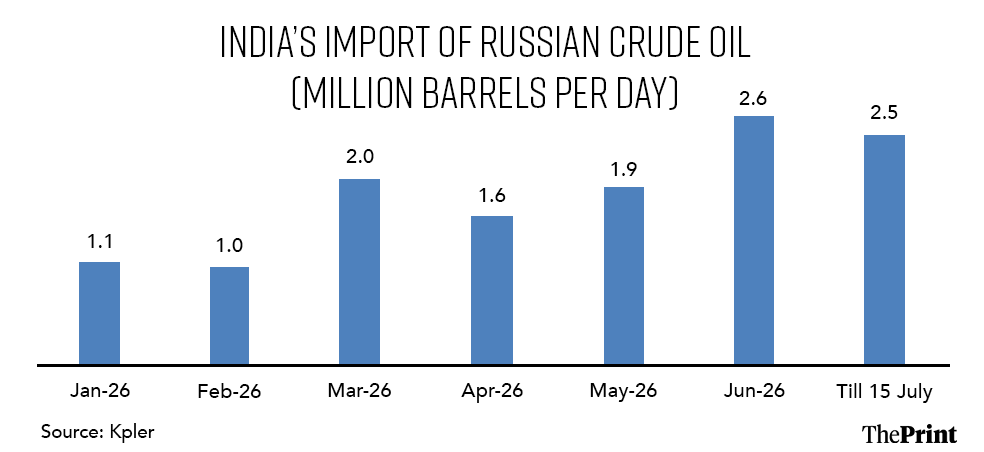
New Delhi: Amid renewed uncertainty around the Strait of Hormuz, Russian crude continues to dominate India’s imports, averaging around 2.5 million barrels per day (mbpd) until 15 July, and expected to remain a key part of the country’s refining mix, according to trade data analytics firm Kpler.
Russia supplied around 2.6 mbpd of crude to India in June, accounting for more than half of the country’s total oil imports. The preliminary July arrivals are also tracking at around 2.5 mbpd, keeping Russia’s share close to 50 percent, Sumit Ritolia, Manager of Oil Markets and Refineries at Kpler, told ThePrint.
“From India’s perspective, Russian crude has become its strongest energy-security hedge, particularly since the Strait of Hormuz disruptions,” Ritolia said.
He said discounted Russian barrels have enabled Indian refiners to maintain high utilisation rates, ensure uninterrupted domestic fuel supplies and avoid feedstock constraints experienced elsewhere in Asia. With remaining alternatives being costlier and limited, Russian crude is unlikely to disappear from India’s refining system anytime soon, he added.
His assessment comes as the Strait of Hormuz, one of the world’s most critical oil transit chokepoints, remains under close watch despite shipping resuming following the interim agreement between the US and Iran.
However, the markets remain wary given the fresh escalation between the two countries.
According to experts, India’s crude position is considerably stronger as refiners have diversified sourcing over the past few years. However, they caution that the country’s dependence on Hormuz remains significant for liquefied petroleum gas (LPG) and liquefied natural gas (LNG), making these energy products far more vulnerable than crude oil.
Also Read: New US sanctions bill targets big 5 buyers of Russian crude. What are the repercussions for India
Cushion in diversification
According to Ritolia, India’s crude import basket is now substantially more diversified, with refiners sourcing oil from Russia, Venezuela, West Africa, and Latin America.
Volumes are also improving from Saudi Arabia and the UAE, as oil is being routed through bypass pipeline infrastructure that reduces reliance on the Strait of Hormuz.
“A renewed disruption would still raise freight, insurance and delivered crude costs, but an immediate physical crude shortage appears manageable,” he said.
Energy expert and Senior Visiting Fellow at George Mason University, Umud Shokri agreed with Ritolia’s assessment, saying India is relatively well positioned because around 70 percent of its crude imports now arrive through routes outside the Strait of Hormuz and refiners source oil from more than 40 countries.
However, he cautioned that diversification does not shield India from higher prices. Russian crude remains linked to global benchmarks and exposed to tanker availability, insurance costs, sanctions, payment challenges and longer shipping distances.
If Gulf exports remain disrupted, competition for Russian, American, African and Latin American barrels would intensify, narrowing discounts and increasing India’s import bill.
“India therefore has a useful buffer against a short-term crude supply shortage, but not against a broader energy-price shock,” Shokri said.
On Gulf supplies, Ritolia said imports are recovering in July, led by Saudi Arabia and the UAE.
Combined Gulf-origin crude imports are tracking at around 1.8 mbpd in July, compared with around 5,00,000 barrels per day in June, although he expects these arrivals to ease as the month progresses.
The increased crude oil volume reflects better availability through Saudi and UAE bypass infrastructure as well as cargoes successfully transiting the Strait of Hormuz.
In contrast, Iraqi crude supplies to India, which stood at around 1 mbpd in January, have fallen sharply over the past three months and are now negligible in July due to transit difficulties through the strait, lack of bypass infrastructure and elevated shipping risks.
India is also expected to continue importing Venezuelan crude as part of its diversification strategy. Ritolia said imports could remain in the range of 3,00,000-4,00,000 barrels per day over the coming months, depending on cargo availability, pricing and the sanctions environment. The heavier, high-sulphur Venezuelan grades remain suitable for India’s complex refineries.
However, he sees little possibility of Iranian crude returning to India anytime soon, saying refiners would require far greater clarity on US sanctions before restarting the purchases. “Compliance, banking, insurance and payment risks continue to outweigh the potential commercial benefits,” Ritolia said.
LPG and LNG weakest link
While crude supplies appear resilient, experts say LPG and LNG remain India’s big vulnerabilities if the Strait of Hormuz faces another prolonged disruption.
Ritolia said LPG imports remain around 50 percent below the pre-conflict levels. With Middle Eastern supplies constrained, the US has become the largest alternative supplier and now accounts for a major share of India’s LPG imports.
However, he said this should not be seen as a permanent shift, as longer voyage times, higher freight costs and infrastructure constraints would limit the ability of US supplies to permanently replace Gulf supplies, which offer scale and logistical advantages.
Shokri said LPG and LNG remain India’s biggest energy vulnerabilities as both rely heavily on supplies from the Gulf passing through the Strait of Hormuz. Any new prolonged disruption could quickly affect household cooking gas availability, forcing the government to again prioritise domestic consumers over commercial users.
Experts say unless LPG and LNG supply chains expand, any renewed disruption in the Strait of Hormuz would likely be felt first through higher cooking gas and natural gas costs rather than an immediate shortage of crude oil.