he expiry of a 25-year gas contract has exposed a shift in the Iran-Turkey energy relationship, with Ankara now enjoying more supply options while Tehran risks losing one of its most dependable export markets.
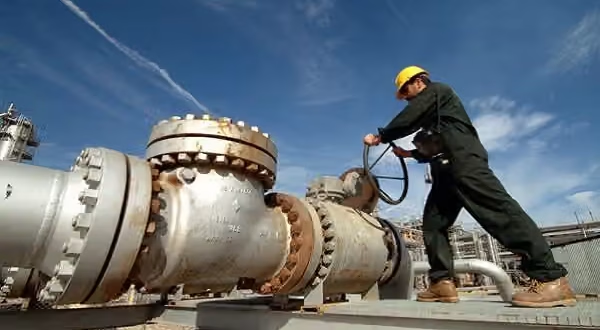
The contract expired on July 29 after governing Iranian pipeline gas supplies to Turkey for 25 years. Signed in 1996, with deliveries beginning in 2001, it provided for up to 9.6 billion cubic meters (bcm) of gas annually through the Tabriz-Ankara pipeline.
Turkish sector sources said the war prevented the two sides from holding negotiations on a new agreement before the deadline, while existing gas flows could continue temporarily under force-majeure arrangements. No new long-term contract has been publicly announced.
The expiry is particularly significant because Iranian supplies were rising sharply immediately before the agreement lapsed. Turkey imported 4.536 bcm of Iranian gas in the first half of 2026, up 34 percent from a year earlier. In June alone, Iran supplied 883 million cubic meters, narrowly behind Azerbaijan and ahead of Russia among Turkey’s pipeline suppliers.
That complicates any assumption that the expiry automatically means the end of Iranian gas exports to Turkey. Instead, it has opened a period in which Ankara must decide how much Iranian gas it still needs and under what terms, while Tehran risks losing or reducing one of its relatively stable sources of export revenue.
The uncertainty has become more consequential as Washington intensifies economic pressure on Tehran. US President Donald Trump on Wednesday announced what he called an “Economic D-Day” against Iran, threatening economic consequences for countries whose financial institutions, businesses or government entities provide Tehran with what he described as economic lifelines.
Trump did not name Turkey or specify how the campaign would affect its purchases of Iranian natural gas. But the announcement adds another potential complication to any attempt by Ankara and Tehran to turn the temporary post-expiry arrangement into a new long-term agreement.
Iran’s gas vulnerabilities
Iran holds the world’s second-largest proven natural gas reserves, yet its export performance remains far below its potential. Production has long been constrained by aging fields, limited investment, insufficient access to technology and exceptionally high domestic consumption.
The South Pars field, shared with Qatar, remains central to Iranian gas production. Israeli strikes in March damaged processing facilities linked to the field and temporarily disrupted exports, although production was subsequently restored at several offshore platforms and gas was redirected to other processing facilities.
The damage has not yet been fully repaired. Iranian Oil Minister Mohsen Paknejad said in August that the war had knocked out about 95 million cubic meters of gas production and that reconstruction of four damaged refineries was continuing. He said the lost capacity was expected to return to the network by the end of September.
Rystad Energy estimates that repairing energy-related infrastructure damaged across the region could cost between $34 billion and $58 billion. Iran accounts for the largest number of affected facilities, with its repair bill potentially reaching $19 billion under the consultancy’s high-damage scenario.
These wartime losses compound problems that predate the conflict. Sanctions have restricted access to investment, technology and international markets, while domestic demand for electricity generation, heating and petrochemicals frequently takes priority over exports.
For Tehran, the Tabriz-Ankara pipeline has therefore been more than simply another commercial route. It has provided revenue, political leverage and a direct energy relationship with one of the region’s largest economies. A substantial reduction in exports to Turkey would leave Iran more dependent on limited pipeline sales to Iraq and Armenia, swaps and other short-term arrangements.
Turkey’s stronger hand
Turkey enters the post-contract period in a far stronger position than when the agreement was signed three decades ago.
Its annual gas demand generally ranges between 50 and 60 bcm, but its supply portfolio has become increasingly diversified. Russia remains a major supplier through Blue Stream and TurkStream, while Azerbaijan supplies gas through the Southern Gas Corridor. LNG has also become an increasingly important component of Turkish supply.
Turkey has expanded LNG import and storage capacity and signed long-term supply agreements with international producers, while domestic production from the Black Sea has continued to grow. Those developments give Ankara substantially more flexibility than it possessed when Iranian pipeline gas became a major part of its energy system.
That does not mean Iranian gas has become irrelevant. Turkish Energy Minister Alparslan Bayraktar said before the contract expired that Turkey could still need the Iranian pipeline for supply security. Turkish sector sources have also described Iranian gas as among the country’s cheapest sources.
The combination gives Ankara considerable leverage. Iran still offers competitively priced pipeline gas delivered through existing infrastructure, but Turkey is no longer as dependent on that supply and has more alternatives with which to negotiate.
What happens after the expiry
Several outcomes remain possible. Turkey and Iran could eventually negotiate another long-term supply agreement, reach a shorter transitional arrangement, reduce contracted volumes or retain Iranian gas primarily as a source of additional supply during periods of high demand.
For Turkey, the calculation will involve not only price and physical supply but also reliability and geopolitical risk. Iranian gas has repeatedly been affected by winter shortages, infrastructure problems and now war, while tighter US economic pressure could create additional uncertainty surrounding payments and future contractual arrangements.
For Iran, the stakes are considerably higher. Reduced exports to Turkey would cut foreign-exchange earnings and further expose the gap between Iran’s enormous gas reserves and its limited ability to monetize them internationally.
The expiration of the old agreement therefore does not yet represent the end of the Iran-Turkey gas relationship. Gas continues to move, and both countries retain reasons to preserve the connection.
But the balance underlying that relationship has changed. Turkey has more suppliers, more infrastructure and greater bargaining power, while Iran faces damaged facilities, sanctions, war and renewed US efforts to restrict its remaining sources of foreign revenue.
The question is no longer whether the 25-year contract will expire. It already has. The question now is whether the gas trade that survived its expiry can be converted into another durable agreement — and on whose terms.

![Numerous merchant ships belonging to Iran and other countries remain at anchor in the Strait of Hormuz in Bandar Abbas, Iran, on September 10, 2026. [Fatemeh Bahrami – Anadolu Agency]](https://uskenergy.com/wp-content/uploads/2026/10/Hormuz-310x165.webp)