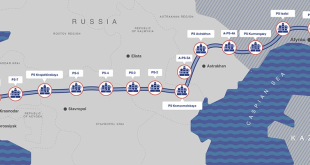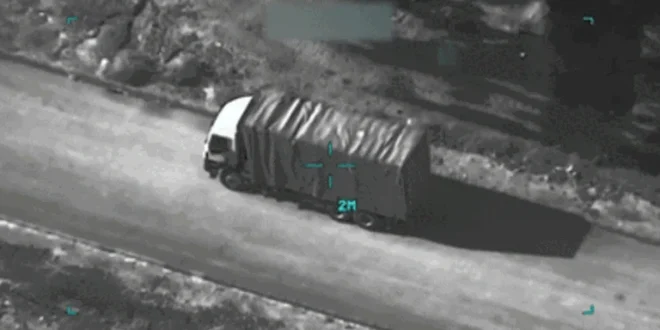
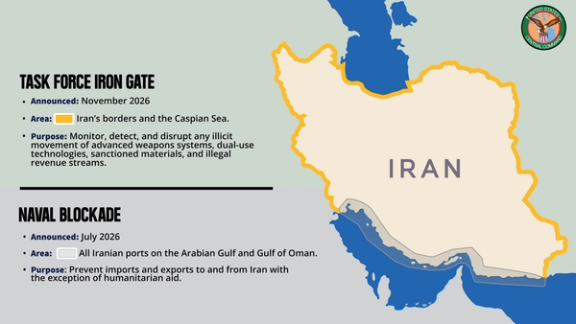
Task Force Iron Gate, a new US team targeting weapons shipments and other illicit flows across Iran’s land borders and the Caspian Sea, may not fully close Iran’s northern supply routes but could make the arms and equipment Tehran needs harder to obtain.
Success will depend less on Washington’s ability to track shipments than on persuading governments, banks and suppliers to stop them.
According to CENTCOM’s November 7 announcement, Iron Gate consists of roughly 20 civilian and military personnel based in Tampa, coordinating with other US agencies.
It follows a naval blockade that CENTCOM estimates has prevented more than $25 billion in crude exports, giving Tehran greater incentive to develop alternative supply routes.
The task force adds coordination capacity, but its announcement offers no indication of new authority to board vessels in the Caspian or access neighboring countries’ ports.
Washington’s leverage lies upstream
A June CSIS assessment argues that Iran needs imported machine tools, electronics and engines to rebuild its military industries. It identifies the Caspian and Pakistan as possible alternatives to disrupted procurement through the United Arab Emirates.
Washington’s strongest leverage may lie with suppliers before those goods reach the region. A distributor with customers in Europe or access to American finance has more to lose than an Iranian shipping company already under sanctions.
Finding that distributor and giving its government evidence of a prohibited sale may achieve more than tracking the vessel carrying the goods.
In September 2024, the State Department designated Russian shipping companies and identified vessels it said transported Iranian military equipment across the Caspian to Russia.
Those measures targeted supplies leaving Iran rather than entering it, but provide an enforcement precedent. They can expose suppliers and discourage businesses from handling their cargo, while offering less leverage over operators whose owners and host governments accept the consequences.
Iron Gate’s better opportunity lies in equipment Iran struggles to replace. A factory awaiting an essential component may remain idle even while food imports grow.
The distinction matters: restricting military procurement does not require closing ordinary commerce, and rising trade volumes would not necessarily mean the task force had failed.
Russia’s role limits US options
Russia poses the hardest problem. Its military relationship with Iran gives Moscow reasons to keep transport connections open, limiting Washington’s prospects of securing cooperation along a major northern route.
In an October analysis for the Yorktown Institute, Nikita Smagin describes expanding Caspian commerce alongside shipping shortages, port limitations and rising freight costs.
The corridor offers Tehran relief but lacks the capacity to replace its southern gateways. That does not mean it cannot carry smaller volumes of militarily important equipment and components.
These constraints could make individual shipments more vulnerable to disruption. They also complicate any assessment of enforcement: congestion, shallow water and seasonal conditions can slow deliveries without American intervention.
Pressure could leave Tehran more reliant on Moscow if other suppliers withdraw while Russian routes stay open.
Iran would then have less room to bargain, while the military partnership Washington hopes to weaken could survive. Economic dependence and military supply would not necessarily move in the direction Washington intends.
Neighbors need different bargains
Kazakhstan illustrates the tension between financial pressure and regional transport ambitions. In May, Deputy Prime Minister Serik Jumangarin said payment risks had stalled contracts with Iran.
A month later, Kazakhstan signed an agreement for a logistics terminal at Iran’s Shahid Rajaee port.
Although the port is on Iran’s southern coast, the project demonstrates Astana’s wider interest in maintaining transport links through Iran. Financial pressure can discourage traders even while their government pursues closer connections.
Washington may therefore have more influence over specific prohibited transactions than over Kazakhstan’s broader commitment to those links.
Azerbaijan suspended cargo crossings on March 5, 2026, after accusing Iran of a drone attack on its territory, then reopened them on March 9.
That episode was a security dispute rather than a sanctions-enforcement test, so it does not establish how Baku would respond to US requests.
The brief closure nevertheless cautions against assuming Azerbaijan would sustain a broad interruption of trade. Requests to inspect specific suspect shipments may have better prospects than demands to shut a major route indefinitely.
Turkmenistan also sees value in keeping Iranian routes open. Its foreign ministry reported talks in September 2025 on increasing transit cargo and developing the China–Kazakhstan–Turkmenistan–Iran railway.
These projects are not evidence of wrongdoing, but they help explain why Ashgabat might resist sweeping restrictions.
Requests to stop weapons shipments backed by clear evidence may find a more receptive audience, although the task force announcement offers no indication that Turkmenistan has agreed to cooperate.
The test is military production
Iranian buyers can change intermediaries more easily than they can replace scarce equipment or technical expertise. Enforcement needs to follow those dependencies rather than simply add names to sanctions lists.
Useful measures of success would include documented procurement failures, interrupted payments, longer waits for critical components and confirmed interceptions of prohibited shipments.
The ultimate test is whether those obstacles constrain the restoration of Iranian military production.
Iron Gate’s best chance lies in restricting difficult-to-replace military inputs while securing cooperation neighboring governments can sustain.
Otherwise, Washington risks making trade more cumbersome—and Iran more dependent on Russia—while leaving its essential military supply relationships intact.