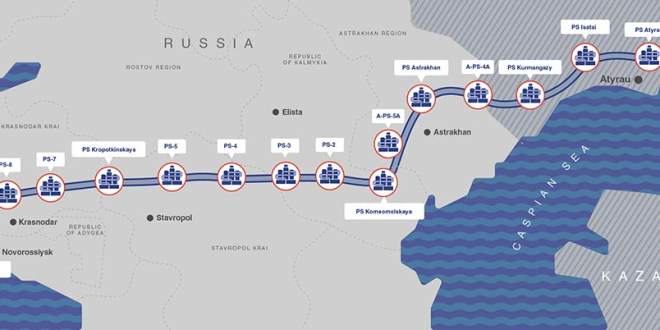
Kazakhstan sent more than four-fifths of its oil exports in 2025 through the Caspian Pipeline Consortium (CPC), which crosses Russia to the Black Sea. Repeated disruptions have exposed the risks of relying so heavily on a single route. While alternative shipments across the Caspian Sea are growing, volumes remain small. Falling water levels and higher transport costs complicate efforts to expand these alternative routes, while tensions around Iran pose risks to routes farther south.
These challenges extend beyond Kazakhstan. The country is Central Asia’s largest oil producer, and its export decisions affect trade and energy infrastructure across the Caspian region, the South Caucasus and Europe. Meanwhile, plans to export renewable electricity across the Caspian could create new connections between Central Asia and European energy markets.
To examine the region’s options, The Times of Central Asia spoke with Dr. Umud Shokri, a Washington-based energy strategist and Visiting Senior Fellow at George Mason University. He is the author of U.S. Energy Diplomacy in the Caspian Sea Basin (Springer, 2021) and is preparing two books: Hormuz and the Geopolitics of Eurasian Energy Infrastructure (Routledge) and Iran’s Energy Transition Under Constraint: War, Sanctions, and Systemic Vulnerability (Springer).
TCA: How is Central Asia’s role in Eurasian energy security changing, and where does Kazakhstan fit into this shift?
Umud Shokri: I think the biggest change is that Central Asian countries are looking beyond the routes they have relied on for decades. Oil and gas still move mainly through Russia and China, but governments are also exploring connections across the Caspian and south through Iran. They want more choices and greater control over how their resources reach markets.
Kazakhstan is central to this shift. It is the region’s largest oil producer, and its location gives it links to Russia, China, the Caspian and the South Caucasus. However, its heavy dependence on a single major oil export route remains a significant vulnerability.
There is also a growing focus on electricity. Azerbaijan, Kazakhstan and Uzbekistan are working on plans for a green-energy corridor across the Caspian. Commissioning of the Central Asia–Azerbaijan link is planned to begin in 2032, while the separate Caspian–Black Sea–Europe corridor is expected to reach full capacity by 2040. These are long-term goals; neither corridor is operating yet.
Kazakhstan is therefore both a major energy supplier and a country seeking to broaden its options. Its relationships with Russia, China, Europe, Türkiye and its neighbors all matter. But diplomacy alone is not enough. The region needs investment in pipelines, ports, power lines and domestic grids to turn diversification plans into reliable alternatives.
TCA: Kazakhstan relies heavily on the CPC pipeline. Can the route through Azerbaijan and Türkiye become a substantial alternative?
Umud Shokri: The CPC is still Kazakhstan’s main oil export route. It carried 64.8 million metric tons of Kazakh oil in 2025, or about four-fifths of the country’s exports. That volume cannot be shifted elsewhere quickly. But repeated disruptions have shown why Kazakhstan needs alternatives.
The route through Azerbaijan and Türkiye is already operating. Kazakh oil is shipped from Aktau across the Caspian to Baku, then moves through the Baku–Tbilisi–Ceyhan (BTC) pipeline, which runs through Georgia and Türkiye to the Mediterranean. Kazakhstan shipped about 1.26 million metric tons through BTC in 2025. In the first nine months of 2026, shipments toward the pipeline reached 1.164 million metric tons, with a target of 1.7 million metric tons for the full year.
That is meaningful progress, but the volumes remain small compared with the CPC. Expanding the route would require more capacity at Aktau and Baku, enough tankers on the Caspian, reliable arrangements with transit partners and room for additional crude in the pipeline system. It also costs more because the oil has to be handled and transferred several times.
I would describe the route as a practical backup, not a near-term replacement for the CPC. Even at today’s scale, it gives Kazakhstan another option when its main outlet is disrupted. The best approach is to increase shipments steadily and coordinate closely with transit partners. The aim is to make Kazakhstan less exposed to any single route, not to switch dependence from one corridor to another.
TCA: The Caspian Sea’s water level continues to fall. What does this mean for Kazakhstan’s ports, oil shipments and plans to expand the Trans-Caspian route?
Umud Shokri: The falling water level is already making shipping more difficult, particularly along Kazakhstan’s shallow coastline. Vessels may have to carry lighter loads, raising transport costs and reducing the competitiveness of oil shipments across the Caspian toward the Baku–Tbilisi–Ceyhan pipeline.
Kazakhstan is responding with dredging at Aktau and Kuryk, but this is a costly, ongoing adaptation rather than a solution to the underlying decline. Ports, ships and loading facilities may also need to adjust to shallower waters.
The risk for Kazakhstan is particularly significant because it is seeking to expand the Trans-Caspian route as an alternative to the CPC. Lower water levels can also affect offshore facilities and threaten coastal ecosystems.
With higher temperatures, evaporation and changing river inflows contributing to the decline, the Caspian states need to coordinate their responses. Sharing water-level data and planning infrastructure adaptation together will be essential. Otherwise, a corridor intended to diversify Kazakhstan’s exports could become less reliable just as the country needs it most.
TCA: Could tensions around Iran and the Strait of Hormuz undermine Central Asia’s plans to develop southern export and transport routes?
Umud Shokri: Central Asian oil and gas do not normally pass through the Strait of Hormuz, so tensions there do not directly close the region’s main export routes. The effects are still felt. Conflict can push up oil and freight prices, increase insurance costs and make companies more cautious about trade and investment. It can also disrupt supplies of goods that Central Asian economies import.
The southern route through Iran is attractive because it offers landlocked countries access to ports and markets in the Gulf and South Asia. Kazakhstan and Iran have agreed to develop a Kazakh logistics terminal at Shahid Rajaee Port in Bandar Abbas. That could support trade, but Bandar Abbas is inside the Persian Gulf. Ships using it remain exposed to risks around Hormuz.
Chabahar is on the Gulf of Oman, outside the Strait, so it offers a different geographic option. But a port’s location is only one part of a corridor. Sanctions, financing, security and the quality of road and rail links all affect whether businesses can use it reliably.
Higher oil prices may bring more revenue to Central Asian exporters, but that benefit can be offset by costlier transport and imports. I would not treat the southern route as a guaranteed alternative to routes through Russia or across the Caspian. It is one option, with its own risks. The region will be better positioned if it develops several usable corridors and can shift trade when one becomes unsafe or too expensive.
TCA: What practical steps should Kazakhstan and its Central Asian neighbors take by 2030–2035 to make their energy systems and export routes more resilient?
Umud Shokri: First, Kazakhstan should focus on building practical alternatives to the CPC without assuming the main route can be replaced quickly. Diversification is most valuable when alternative corridors have the operational capacity and reliable transit arrangements needed to handle additional volumes during disruptions.
The region should also be realistic about green-energy plans. The proposed Central Asia–Azerbaijan corridor could become important, but it needs new renewable generation, transmission links, financing and agreements on how electricity will be traded. Governments should distinguish clearly between what is planned, what is being built and what is already operating.
Another priority is strengthening regional energy resilience. Cooperation on electricity grids, seasonal balancing and emergency supply could improve security even before major export projects are completed. Joint planning for changing Caspian conditions should also form part of a broader regional strategy.
Finally, Central Asian governments should keep their diplomatic and commercial options open. Every route has political, financial and security risks; the goal is to avoid becoming too dependent on any single transit country or market.
By combining more export options with stronger domestic grids and better regional planning, Kazakhstan and its neighbors can make disruptions easier to manage. They cannot remove geopolitical risk, but they can reduce the cost of being caught with only one way forward.