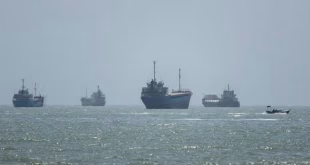
The 2025-2026 Iran-Israel-U.S. conflict marked a turning point in global energy politics. Direct attacks on Iranian energy infrastructure, such as South Pars and the Kharg Island export terminal, along with Iranian threats to disrupt the Strait of Hormuz, revealed the weakness of maritime chokepoints. About 20% of the world’s seaborne crude oil and major LNG flows move through Hormuz, so any disruption there poses a risk to global energy markets.[1]
The crisis greatly reduced shipping traffic and pushed Brent oil prices above US$100 per barrel at peak times, causing significant revenue losses for Gulf exporters. Insecurity in the Red Sea, partly driven by regional allies, further increased the risks for maritime trade.[2] These disruptions sped up the search for overland routes, flexible LNG supply chains, and reliable transit countries. Türkiye’s location at the crossroads of the Caspian Sea, Black Sea, Iraq, Eastern Mediterranean, and Europe has gained new strategic importance. Ankara has long aimed to be an energy hub through pipeline diplomacy, market opening, and diversification. The post-war situation gives Türkiye a better chance to link alternative producers with European and regional buyers while lowering its vulnerability to Hormuz-style disruptions.[3]
Pipeline diplomacy: Türkiye’s overland advantage
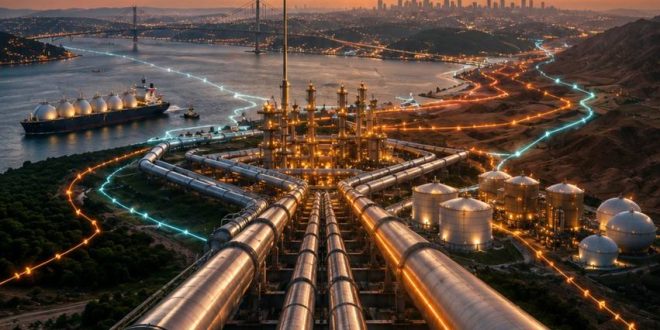
Türkiye’s biggest strength in the post-war energy landscape is its geography. The Iran-Israel-U.S. war showed how risky it is for global energy markets to depend too heavily on maritime chokepoints, especially the Strait of Hormuz. As a result, overland routes have become more attractive. Türkiye is already connected to several of them, linking Caspian, Russian, Iraqi, and potentially Gulf energy supplies to European and Mediterranean markets.
The Baku-Tbilisi-Ceyhan oil pipeline is one of the clearest examples of Türkiye’s value as a non-Hormuz route. It carries Caspian crude to the Mediterranean port of Ceyhan, giving producers an export option that avoids the Gulf. In the current environment, this matters more than before. Ceyhan is not just another port; it is a strategic outlet for oil flows that need to avoid vulnerable maritime routes.[4]
Gas infrastructure gives Türkiye an even larger role. The Trans-Anatolian Natural Gas Pipeline (TANAP), operational since 2018, carries Azerbaijani gas from Shah Deniz Phase 2 across Türkiye and connects to Europe through the Trans-Adriatic Pipeline. With an initial capacity of 16 billion cubic meters (bcm)/year and room for expansion, TANAP strengthens Türkiye’s position between Caspian producers and European consumers. It also gives Ankara a platform to bring in additional gas from other suppliers if political and commercial conditions improve.[5]
TurkStream adds another layer to this picture. Since 2020, it has carried Russian gas across the Black Sea to Türkiye and then onward to Southeast Europe. Its two lines have a combined capacity of about 31.5 bcm/year. For Ankara, this increases Türkiye’s importance as a transit country. But it also creates a balancing problem. Türkiye benefits from moving Russian gas, while Europe is trying to reduce dependence on Moscow. That makes TurkStream useful, but politically sensitive.[6]
The Iraq-Türkiye Pipeline, also known as Kirkuk-Ceyhan, has become more important after the war. With a capacity of up to 1.5–1.6 million barrels per day (bpd), it could offer Iraq and nearby Gulf producers a stronger route to the Mediterranean. During the 2025–2026 crisis, restart volumes were reportedly between 100,000 and 250,000 bpd. The bigger question now is whether the system can eventually be extended south toward Basra. If that happens, Iraqi crude could move more easily through Türkiye instead of relying so heavily on southern export routes exposed to Gulf insecurity.[7]
The Trans-Caspian Gas Pipeline has also gained new relevance. Turkmenistan holds some of the world’s largest gas reserves, and a pipeline across the Caspian Sea to Azerbaijan, Türkiye, and Europe could bring an estimated 20–30 bcm/year into the Southern Gas Corridor. Turkish officials, including Energy Minister Alparslan Bayraktar, have supported the idea. Better Azerbaijan-Turkmenistan relations and swap arrangements have made the project more realistic than before. Still, financing, legal issues, and technical challenges remain serious obstacles. The subsea section alone could cost around US$2 billion, but the political argument for the project is now stronger because buyers are looking for routes less exposed to maritime disruption.[8]
Other proposals are more uncertain but still important to watch. A Qatar-Türkiye gas corridor through Saudi Arabia, Jordan, and Syria would be difficult to build, but it reflects the same larger trend: producers and consumers are looking for land-based alternatives. Possible links between Syrian fields and Iraqi-Turkish infrastructure follow a similar logic. These ideas also connect with Türkiye’s “Development Road Project”, which aims to link the Gulf to Türkiye through Iraq by combining transport, trade, and energy infrastructure. For now, these projects face major barriers, including insecurity in Iraq and Syria, Iraqi federal-KRG disputes, financing problems, and the need for regional political coordination.[9]
The larger point is simple: the war has made Türkiye’s pipeline geography more valuable. Routes that bypass Hormuz now look more attractive, and Türkiye can present itself as a practical connector between producers and consumers. But this opportunity is not guaranteed. Ankara will need stable partnerships, credible investment conditions, and careful diplomacy to turn its location into lasting influence. Without that, Türkiye risks remaining an important transit country rather than becoming a true energy hub.[10]
LNG infrastructure and trading hub development
Türkiye has expanded its LNG infrastructure to lessen reliance on pipeline gas and boost market flexibility. By 2025, regasification capacity reached about 51 bcm/year through onshore terminals at Marmara Ereğlisi and EgeGaz Aliağa, along with floating storage and regasification units at Etki, Dörtyol, and Saros. LNG imports have increased, backed by BOTAŞ contracts with suppliers from the U.S., Qatar, Mercuria, BP, ENI, Shell, ExxonMobil, and Woodside. LNG now makes up a larger portion of Türkiye’s gas supply. This shift helps Ankara renegotiate contracts, protect against price swings, and reduce reliance on a single supplier.[11]
Ceyhan could become more than an oil export point. With the right investment, it could develop into an LNG export and trading center, while Istanbul’s planned gas exchange could help Türkiye shape regional pricing and support re-exports to Europe. This flexibility mattered during the Hormuz disruption, when Türkiye was better placed to shift between suppliers than countries locked into fixed pipeline flows or exposed maritime routes. For Ankara, LNG is not just another source of gas. It is a practical tool for bargaining, managing crises, attracting suppliers, and linking Turkish gas markets more closely with the Balkans through reverse flows and interconnectors.[12]
Domestic production, renewables, and nuclear power
Türkiye’s hub ambitions also depend on reducing domestic import dependence. Its National Energy Plan for 2020–2035 prioritizes domestic production, renewable expansion, nuclear power, and grid modernization. The Black Sea gas discoveries, especially the Sakarya field, have become central to this strategy. Sakarya is estimated to hold around 710 bcm of reserves, with additional discoveries such as Göktepe-3 strengthening Türkiye’s resource base. Production reached initial commercial levels in 2025–2026, with targets of around 40 million cubic meters (mcb) per day by 2028. If achieved, Black Sea gas could eventually meet a significant share of domestic demand.[13]
Renewables are another pillar of Türkiye’s energy resilience. Hydropower remains important, while solar and wind capacity have expanded through YEKA auctions, offshore wind planning, geothermal development, and battery storage targets. The government aims to raise the share of renewables in installed electricity capacity while modernizing the grid to handle more variable generation.[14]
Nuclear power adds another layer to Türkiye’s diversification strategy. The Russian-built Akkuyu Nuclear Power Plant, with a planned capacity of 4,8 GW, is expected to begin operations with its first unit in 2026. Once fully operational, Akkuyu could supply a meaningful share of Türkiye’s electricity demand and reduce the need for gas-fired power generation. Further nuclear expansion is planned as part of Türkiye’s long-term goal of reaching 20 GW of nuclear capacity by 2050.[15] Together, Black Sea gas, renewables, and nuclear power could reduce Türkiye’s gas import needs. This would free more infrastructure for transit and trading purposes, making Türkiye a more credible energy hub.
Geopolitical and economic implications
The Iran-Israel-U.S. war has changed how governments and energy companies think about supply security. The conflict showed how quickly instability around the Strait of Hormuz can threaten oil and LNG flows, disrupt shipping, and force buyers to search for safer routes. For Türkiye, this creates a real opening. Ankara has wanted to become a regional energy hub for years, but the post-war environment makes that goal feel more urgent and more achievable.[16]
Türkiye’s main advantage is location. It sits between major energy producers and major energy consumers. Through existing and potential routes, it can help move supplies from the Caspian, Iraq, Russia, the Eastern Mediterranean, and possibly the Gulf toward European markets. This matters because Europe still wants more diversified supplies, while producers also want routes that are less exposed to maritime disruption.[17]
There is also a clear economic upside. More pipeline flows, LNG activity, and storage capacity would bring Türkiye transit fees, infrastructure investment, and stronger trading opportunities. Turkey has already expanded its LNG capacity, which gives Ankara more flexibility when negotiating contracts or responding to market shocks. If Türkiye combines this flexibility with stronger pipeline links and clearer market rules, it can move closer to being a real energy hub rather than just a country that energy passes through. That difference is important. A transit country mainly provides the route. A hub helps shape the market. It influences contracts, prices, storage, re-exports, and supply decisions during crises. Türkiye’s ambition is not only to connect producers and consumers, but to gain a stronger voice in how regional energy markets work. That is where the real geopolitical value lies.[18]
The political benefits could be just as important as the economic ones. Energy connectivity gives Ankara another tool in its relations with Europe, the Gulf states, Azerbaijan, Russia, and the United States. In the post-war setting, Türkiye can present itself as useful to all sides: a country that can support European energy security, offer producers alternative routes, and still maintain room to maneuver among competing powers.
But Türkiye’s opportunity is not guaranteed. Eastern Mediterranean disputes still limit cooperation with Israel and southern Cyprus. Instability in Iraq and Syria could delay new projects. Security risks in southeastern Türkiye remain a concern. Financing will also be difficult, especially for large pipeline projects that need long-term contracts and political guarantees. Türkiye has geography on its side, but geography does not magically solve politics, as much as mapmakers might wish otherwise. Türkiye also must think beyond the immediate fossil fuel opportunity. Europe’s energy transition could reduce demand for some oil and gas infrastructure over time. To protect its hub ambition, Ankara will need to link pipeline transit and LNG flexibility with electricity trade, renewables, storage, nuclear power, and eventually low-carbon corridors. The post-war moment gives Türkiye a stronger chance to become a regional energy hub, but success will depend on whether it can turn location into reliability, market depth, and long-term trust.[19]
Conclusion
The Iran-Israel-U.S. war has made Türkiye’s energy hub plan feel more urgent and more realistic. The conflict showed how quickly global energy markets can come under pressure when oil and gas depend on chokepoints such as the Strait of Hormuz. As buyers look for safer routes, Türkiye’s position becomes more valuable. Its pipelines, LNG capacity, Black Sea gas, renewables, and nuclear plans give Ankara stronger tools to connect producers in the Caspian, Iraq, the Gulf, Russia, and the Eastern Mediterranean with consumers in Europe and the wider region.
But geography alone will not make Türkiye a real energy hub. Sitting between producers and consumers is useful, but it is only the starting point. Türkiye also needs clearer market rules, transparent pricing, reliable investment conditions, and trading systems that partners can trust. Pipelines and terminals can move energy, but trust is what turns a transit route into a real hub. Without that, Türkiye may remain an important corridor rather than becoming a place where regional energy decisions are shaped.
The opportunity is real, but so are the risks. Instability in Iraq and Syria, Eastern Mediterranean disputes, tensions with Russia, financing problems, and Europe’s energy transition could all slow Ankara’s plans. A hub built only around oil and gas may look strong today but less secure tomorrow. That is why Türkiye’s strategy needs to include LNG, electricity links, renewables, storage, nuclear power, and eventually low-carbon corridors. The war did not create Türkiye’s hub ambition, but it made the case stronger. If Ankara can turn infrastructure into trust and transit into trade, it could play a much larger role in European and regional energy security.
[1] Anne-Sophie Corbeau, Erica Downs, Ira Joseph, Richard Nephew, Daniel Sternoff, Karen E. Young, Robin Mills, and Neelesh Nerurkar, “Live Updates: US-Israeli Attacks on Iran and Global Energy Impacts,” Center on Global Energy Policy at Columbia University SIPA, April 28, 2026, https://www.energypolicy.columbia.edu/us-israeli-attacks-on-iran-and-global-energy-impacts/.
[2] The Soufan Center, “Iran-Israel Conflict Demonstrated Vulnerability of Global Energy Supply Chains,” IntelBrief, June 27, 2025, https://thesoufancenter.org/intelbrief-2025-june-27/.
[3] Aliaksandr Novikau and Jahja Muhasilović, “Turkey’s Quest to Become a Regional Energy Hub: Challenges and Opportunities,” Heliyon 9, no. 11 (2023): e21535. https://doi.org/10.1016/j.heliyon.2023.e21535.
[4] “Türkiye Gains Edge Bypassing Hormuz via Basra-Ceyhan, BTC Expansions: IEA,” Türkiye Today, April 21, 2026, https://www.turkiyetoday.com/business/turkiye-gains-edge-bypassing-hormuz-via-basra-ceyhan-btc-expansions-iea-3218519.
[5] A&M Consultancy, “Oil & Gas in Turkey.” Mondaq, October 16, 2024, https://www.mondaq.com/turkey/oil-gas-electricity/1530792/oil-gas-in-turkey.
[6] “Gas Pumped via TurkStream European Line Increases 21% in January–March 2026,” Interfax, April 1, 2026, https://interfax.com/newsroom/top-stories/116906/.
[7] Charles Kennedy, “Iraq To Restore Kirkuk-Turkey Pipeline as Iran War Chokes Off Exports,” OilPrice.com, March 16, 2026, https://oilprice.com/Latest-Energy-News/World-News/Iraq-To-Restore-Kirkuk-Turkey-Pipeline-as-Iran-War-Chokes-Off-Exports.html.
[8] Ole Gunnar Austvik and Gülmira Rzayeva, “Turkey in the Geopolitics of Natural Gas,” M-RCBG Associate Working Paper Series, no. 66. Mossavar-Rahmani Center for Business and Government, Harvard Kennedy School, September 2016, https://www.hks.harvard.edu/sites/default/files/centers/mrcbg/files/66_final.pdf.
[9] Emre Erşen and Mitat Çelikpala, “Turkey and the Changing Energy Geopolitics of Eurasia,” Energy Policy 128 (2019): 584–592, https://doi.org/10.1016/j.enpol.2019.01.036.
[10] Francesco Siccardi, “Understanding the Energy Drivers of Turkey’s Foreign Policy,” Carnegie Endowment for International Peace, February 28, 2024, https://carnegieendowment.org/russia-eurasia/research/2024/02/understanding-the-energy-drivers-of-turkeys-foreign-policy.
[11] Eser Özdil, “Turkey’s Gas Diversification Strategy and Rising Share of LNG,” Atlantic Council, March 3, 2026, https://www.atlanticcouncil.org/in-depth-research-reports/issue-brief/turkeys-gas-diversification-strategy-and-rising-share-of-lng/.
[12] Lauren Holtmeier, “Turkey Plans New Gas, Crude Export Pipelines to Iraq through Ceyhan,” S&P Global, April 13, 2025, https://www.spglobal.com/energy/en/news-research/latest-news/crude-oil/041325-turkey-plans-new-gas-crude-export-pipelines-to-iraq-through-ceyhan.
[13] International Trade Administration, U.S. Department of Commerce, “Turkey – Oil and Gas Equipment – LNG and LNG Terminals, Upstream, Downstream and Midstream,” Trade.gov, February 5, 2026, https://www.trade.gov/knowledge-product/turkey-oil-and-gas-equipment-lng-and-lng-terminals-upstream-downstream.
[14] David O’Byrne, “Turkey Outlines Renewable Power Plans to 2035,” S&P Global, October 21, 2024, https://www.spglobal.com/energy/en/news-research/latest-news/electric-power/102124-turkey-outlines-renewable-power-plans-to-2035.
[15] Emese Fabian, “The Turkish Path – What Does Türkiye Plan Regarding Russian and US Gas?” CEENERGY NEWS, December 4, 2025, https://ceenergynews.com/oil-gas/turkiye-russian-us-gas/.
[16] Candace Dunn and Justine Barden, “Amid Regional Conflict, the Strait of Hormuz Remains Critical Oil Chokepoint,” Today in Energy, U.S. Energy Information Administration, June 16, 2025, https://www.eia.gov/todayinenergy/detail.php?id=65504.
[17] Aliaksandr Novikau and Jahja Muhasilović, “Turkey’s Quest to Become a Regional Energy Hub: Challenges and Opportunities,” Heliyon 9, no. 11 (2023): e21535, https://doi.org/10.1016/j.heliyon.2023.e21535.
[18] Pınar Dost, “How Energy and Trade Are Redefining US–Turkey Regional Cooperation,” Atlantic Council, October 9, 2025, https://www.atlanticcouncil.org/blogs/turkeysource/how-energy-and-trade-are-redefining-us-turkey-regional-cooperation/.
[19] “Turkey Plans TANAP-Style Electricity Corridor with Azerbaijan, Minister Says,” Reuters, June 1, 2026, https://www.reuters.com/business/energy/turkey-plans-tanap-style-electricity-corridor-with-azerbaijan-minister-says-2026-06-01/.

![Numerous merchant ships belonging to Iran and other countries remain at anchor in the Strait of Hormuz in Bandar Abbas, Iran, on September 10, 2026. [Fatemeh Bahrami – Anadolu Agency]](https://uskenergy.com/wp-content/uploads/2026/10/Hormuz-310x165.webp)