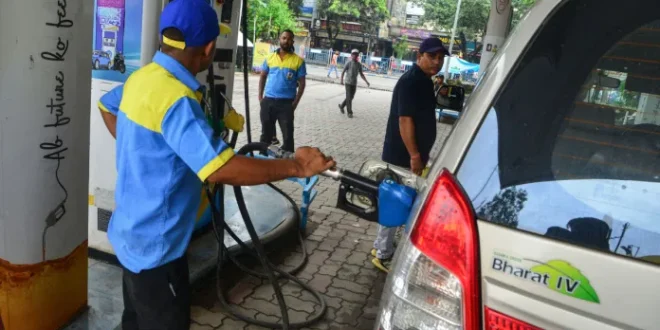
Brent crude rises to highest level in nearly a month as US-Iran deadlock keeps Strait of Hormuz disrupted, raising risks of higher import bills, fuel prices & inflation for India.
New Delhi: Nearly six months into the US-Iran war, the oil market is again facing supply uncertainty, with Brent crude climbing close to $94 a barrel as hopes of a diplomatic breakthrough between Washington and Tehran fade.
For India, which imports nearly 85 percent of its crude oil requirements, a prolonged rise in global oil prices could mean a higher import bill, greater dollar demand and pressure on the rupee and current account. The impact could eventually reach consumers through higher fuel and transportation costs.
Brent futures settled at around $94 per barrel on Thursday, rising 2.4 percent and touching their highest level in nearly a month. The rise came after an interim US-Iran ceasefire that began on 17 June effectively collapsed and a 60-day negotiating window expired this week without a breakthrough.
Brent crude is a global price benchmark for oil produced from fields in the North Sea.
The Strait of Hormuz remains at the centre of the risk. Before the war began at the end of February, around one-fifth of global oil supplies moved through the waterway. Any prolonged disruption could tighten global supplies and push prices higher.
The supply concerns are not limited to the Gulf region. The crude oil shipments from Russia’s ports fell 15 percent to around 2.3 million barrels per day in the first half of August because of disruptions at the Black Sea port of Novorossiysk following Ukrainian drone attacks, according to Reuters.
Import bill, rupee to feel the first hit
In India, the first impact of higher crude prices will be on the country’s import bill and the rupee.
“India’s heavy dependence on imported crude means that any sharp increase in oil prices impacts the economy almost immediately through higher import costs and pressure on the rupee,” said Praveen Rai, the director for oil markets at Grant Thornton Bharat, an advisory and consulting firm.
A $10 a barrel increase in crude prices can add around $12-15 billion to India’s annual import bill, Rai said.
Higher crude prices also mean greater demand for dollars from refiners, while State-owned oil marketing companies could face margin pressure if domestic petrol and diesel prices are not raised in line with global crude.
“The first impact will be a higher oil-import bill, stronger demand for dollars from refiners, and additional pressure on the rupee,” said Umud Shokri, energy expert and senior visiting faculty at George Mason University in the US.
The impact would then spread to airlines, transport, logistics, petrochemicals and other energy-intensive sectors. Consumer inflation, however, may take longer to rise because domestic fuel prices are not immediately or fully linked to international crude prices.
Arya Roy Bardhan, junior fellow at Observer Research Foundation (ORF), said the impact could spread beyond fuel to freight, fertilisers and food. “With Brent above US$90, India faces a higher import bill, pressure on the rupee and current account, and wider inflation through fuel, freight, fertilisers and food prices,” he said.
With global oil prices elevated, the key question is whether oil marketing companies will continue to absorb higher costs or pass it on to the consumers.
ThePrint has written to the Ministry of Petroleum and Natural Gas (MoPNG) seeking clarity on any plans for a fuel-price hike, but had not received a response at the time of publication.
Shokri expects any increase to be gradual “rather than a sharp one-time increase”.
Rai said the government could consider other measures before raising fuel prices, as it did during the March-May disruption, when it cut excise duty by Rs 10 per litre, revised export duties, increased LPG production and prioritised supplies for household and Ujjwala consumers.
If oil crosses $100, India faces a tougher choice
The bigger concern for India would be Brent crude moving above $100 a barrel and staying there for a prolonged period. Rai said a temporary spike above that level is possible if geopolitical tensions worsen or disruptions spread to key shipping routes and oil-exporting countries.
A sustained rally above $100 per barrel would mean a higher import bill, greater pressure on the current account deficit, and higher transportation costs for the country.
For the government, keeping fuel prices low for too long could pressure public finances and the balance sheets of State-owned oil marketing companies. But allowing prices to rise faster would increase the burden on consumers.
Over the last few months, India has diversified its crude sources, which Rai said provides a stronger buffer. However, it cannot fully shield the economy from prolonged high prices.
The government response is, therefore, likely to involve several measures rather than a single intervention.
Rai expects a combination of targeted subsidies and selective tax cuts, along with foreign-exchange measures, greater diversification of crude supplies from the US, Africa and Latin America, and the use of strategic petroleum reserves during a serious supply disruption.
(Edited by Ajeet Tiwari)