February 25, 2026 at 01:32 PM
At a time when global trade and transportation routes are undergoing sharp transformations, the growing role of the Middle Corridor is being widely discussed in international expert circles.
This was stated in a comment to The Daily Baku by US-based energy strategist and researcher at George Mason University, Umud Shokri.
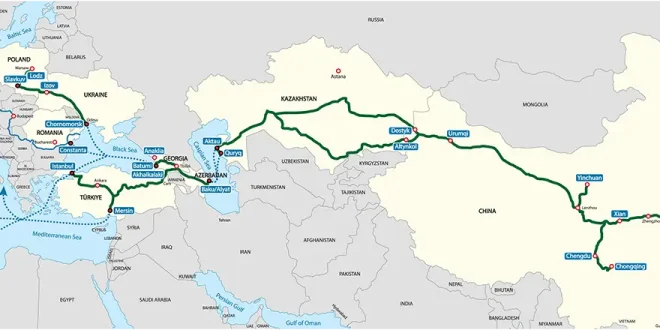
According to him, the main advantage of the Middle Corridor is that it serves as the most reliable and geopolitically secure overland trade route between East Asia, particularly China, and Europe. The expert noted that the corridor is of particular importance in the current international environment because it bypasses both Russian and Iranian territory: “The Northern Corridor has faced serious challenges following the war in Ukraine due to Western sanctions, regulatory uncertainties, insurance problems, and reputational risks. On the other hand, traditional maritime routes through the Suez Canal and the Red Sea are marked by security risks and longer transit times.”
Umud Shokri stressed that against this backdrop, the Middle Corridor offers shorter transit times, greater predictability, and resilience to geopolitical shocks. “The average transit time along the Middle Corridor for China–Europe shipments is around 18 days. In some cases, this is even shorter than routes passing through Russia. For this very reason, the corridor is no longer merely an alternative, but is increasingly becoming the preferred strategic vector,” he said.
According to the expert, the rapid growth in cargo volumes along this route is a tangible indicator of rising interest in the Middle Corridor. Before 2022, its share in China–Europe trade was below 1 percent, but shipments along this line have increased sharply in recent years. “In 2024 alone, cargo volumes rose by 62 percent to reach 4.5 million tons. Forecasts suggest that this figure could exceed 11 million tons by 2030,” Shokri noted. He added that this growth is directly linked to the growing emphasis on diversification and precautionary strategies in global supply chains.
The statement also gave particular attention to the impact of the normalization of Armenia–Azerbaijan relations on the development of the Middle Corridor. Umud Shokri said that peace or a serious normalization process between the two countries could remove key obstacles in the South Caucasus segment and ensure the corridor operates at full capacity. “The agreements reached in Washington in August 2025 and the ‘Trump Route for International Peace and Prosperity’ – TRIPP, which has since come to the forefront, are significant in this regard. This 43-kilometer multimodal line passing through Armenia’s Syunik region will not only connect Azerbaijan with Nakhchivan, but also facilitate access to Türkiye and Europe,” he emphasized.
The expert noted that the TRIPP project creates new opportunities not only for logistics, but also for energy, fiber-optic communications, and potential pipelines. “This route could generate additional cargo capacity of up to 15 million tons annually, expand intra-regional trade, and contribute to long-term stability through economic interdependence,” Umud Shokri said. In his view, the process also attracts Western investment and moves regional projects into a more practical phase.
Azerbaijan’s role was particularly highlighted in the statement. Umud Shokri said that Azerbaijan stands at the center of this geo-economic transformation: “Azerbaijan is the key link connecting the Caspian crossing with the South Caucasus and Europe. Investments in the ports of Alat and Baku, railway infrastructure, digital customs systems, and energy projects have turned the country into the operational hub of the Middle Corridor.” He added that Azerbaijan’s institutional experience in the energy sector and its capacity for multilateral cooperation further strengthen this process.
The expert recalled that Azerbaijan’s full participation in the expansion of the Central Asia format from C5 to C6 in 2025 also boosted the formation of the Middle Corridor as a unified geo-economic space. “The US–Azerbaijan Strategic Partnership Charter signed in February 2026 clearly demonstrates that Washington views Baku as one of its key partners in this process,” he noted.
In conclusion, Umud Shokri stressed that to ensure the sustainability of the process, it is essential to strengthen institutional mechanisms, clarify governance and security issues related to the TRIPP project, and secure more active participation from European and US financial institutions. “If these steps are taken, the Middle Corridor could lay the foundation for a new, stable and reliable connectivity model along the Caucasus–Central Asia axis in the coming years and further reinforce Azerbaijan’s international position as a middle power,” the expert concluded.

![Numerous merchant ships belonging to Iran and other countries remain at anchor in the Strait of Hormuz in Bandar Abbas, Iran, on September 10, 2026. [Fatemeh Bahrami – Anadolu Agency]](https://uskenergy.com/wp-content/uploads/2026/10/Hormuz-310x165.webp)