The project fits a long-standing pattern in Iran of improvisation rather than reform
On December 6, Iran’s President Masoud Pezeshkian unveiled the country’s latest attempt to mitigate chronic water shortages: an 800-kilometer pipeline carrying desalinated water from the Gulf of Oman to drought-stricken Isfahan.
The two-year, 350 trillion rial (about $300 million) project was largely financed by Mobarakeh Steel Company, Iran’s largest steel producer. Officials have billed it as a “strategic lifeline” for industry and a relief valve for the Zayandeh Rud, the river that once powered Isfahan’s economy but now runs dry for much of the year due to mismanagement and drought.
Iran faces an escalating domestic crisis driven by chronic water shortages and rolling blackouts, with Tehran teetering on the edge of “water bankruptcy” amid historically low reservoirs and emergency cloud-seeding operations. Satellite imagery shows Iran entering its worst water emergency in half a century, and environmental analysts warn that the pipeline is more stopgap than solution, skirting the structural failures driving the crisis. The project’s rapid rollout, the politics behind it, and its broader consequences reveal a model of water governance that Iran can no longer afford.
While the pipeline may ease short-term pressure on the Zayandeh Rud, experts warn it merely displaces the crisis. Desalination produces hypersaline brine, which, if discharged improperly, could raise salinity in parts of the Gulf of Oman by up to 1.5 times and increase water temperatures by 2°C, threatening marine ecosystems and already stressed fisheries. The pipeline itself crosses some of Iran’s driest terrain, where heat and exposure could evaporate 20–30% of the transported water, while brine residues risk contaminating fragile soils. Iran’s Department of Environment has repeatedly opposed such transfers, highlighting the Persian Gulf’s vulnerability due to shallow depths, high evaporation, and chronic oil pollution.
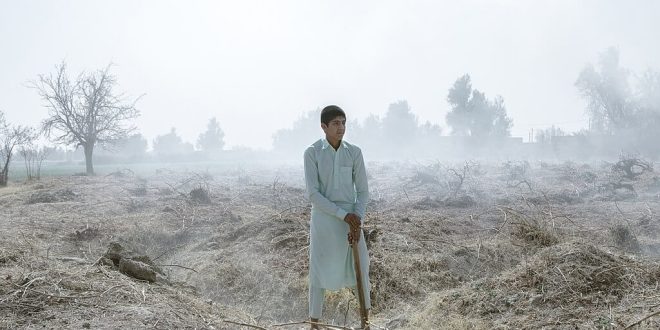
The deeper problem is that the project fits a long-standing pattern in Iran of improvisation rather than reform. Agriculture consumes roughly 90% of Iran’s water while contributing only about 12% of GDP, a ratio driven by inefficient flood irrigation and water-intensive crops like rice cultivated in arid basins. Groundwater extraction exceeds natural recharge by two- to threefold in many plains, causing land subsidence of 25–35 centimeters per year and collapsing centuries-old qanats.
Wetlands such as Lake Urmia have shrunk by around 90%, helping generate dust storms that now sweep across the Middle East. Iran ranks among the 25 countries facing “extremely high-water stress,” according to the World Resources Institute.
Experts including Kaveh Madani, a former deputy head of Iran’s Department of the Environment who now directs the United Nations University Institute for Water, Environment and Health, warn that mega-projects like the pipeline siphon resources from practical and more viable fixes such as modernizing irrigation or repairing urban water networks that lose nearly 30% of supply to leaks. Without addressing agricultural overuse, long defended under the ideology of national “self-sufficiency” and the “resistance economy,” desalination pipelines risk becoming costly white elephants that further drain public finances already depleted by sanctions.
Beyond ecological risks, the project’s infrastructure introduces additional pressures. Brine discharge into the open sea is moving forward without long-term monitoring, and desalination requires 3–5 kWh of electricity per cubic meter, a significant burden on a national grid already plagued by blackouts.
Pezeshkian’s launch of the pipeline does serve several political purposes. Domestically, it seeks to bolster his reformist credentials in the face of widespread disillusionment with his record since his election in 2024. Framing the project as a lifeline for industrial production, especially for Mobarakeh Steel, a key economic engine, directly appeals to working-class voters in Isfahan, one of his strongest constituencies. His broader coastal emphasis also echoes his proposal to relocate Iran’s capital to the Makran region, a move he argues could escape Tehran’s sinking aquifers and seismic risks, though experts remain doubtful that such a shift would meaningfully reduce national water demand.
The pipeline also allows the government to sidestep far more contentious reforms that could negatively impact the so-called water mafia. Firms linked to the powerful Islamic Revolutionary Guard Corps dominate dam-building and water-transfer contracts, profiting while dismissing environmental objections. Pezeshkian’s order to fast-track dams such as Khersan-3, despite lacking permits, has already triggered clashes in Yasuj, an industrial city in southwest Iran, where residents accuse authorities of sacrificing forests and local livelihoods for central water transfers. This top-down model, virtually unchanged since 1979, continues to privilege elite interests over equitable water distribution, fueling recurring unrest from Khuzestan to Tehran.
Internationally, the pipeline serves as a geopolitical signal. Officials highlight the project as evidence of Iran’s ability to innovate under sanctions, including the deployment of domestically developed reverse-osmosis technology. But regional implications are harder to control and could undermine Iranian attempts to improve relations with neighbors.
Economically, the pipeline helps secure steel production, one of Iran’s few reliable export sectors, but does so at the cost of rising energy expenditures and worsening agricultural productivity, increasing food inflation now surpassing 50% for staples like rice.
On the security front, worsening water scarcity erodes rural support for the regime and heightens tensions with Iraq and Afghanistan over shared river basins. Globally, Iran’s trajectory warns of what lies ahead for other arid nations: Without transparent water allocation, genuine efficiency reforms, and functional transboundary agreements such as those envisioned under the 1978 Kuwait Convention, large-scale engineering projects risk speeding collapse rather than preventing it.
In the end, Pezeshkian’s pipeline buys time for factories in Isfahan but further entrenches a governance model that has pushed Iran’s water system to the brink. Real relief requires politically risky steps the state has avoided for decades: curbing subsidies, shutting illegal wells, enforcing groundwater limits, and decentralizing water management. As Madani cautions, “extreme drought is the auditor, not the cause.” Until accountability outweighs ideology, Iran’s thirst will only deepen.


![This handout image taken by the European Space Agency, captured by the Copernicus Sentinel-2 satellite, shows a view of Iran's Kharg island. [AFP]](https://uskenergy.com/wp-content/uploads/2026/03/Representational-Image-2026-03-14T174826.509-2026-03-cfb0244d80bdb96caafe790a619f1ef9-310x165.avif)