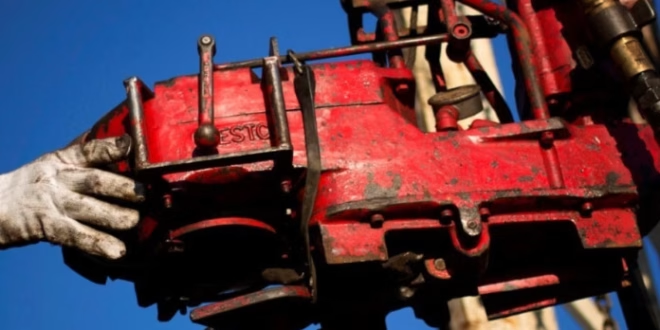
Analysts broadly expect countries to start replenishing at least some of their depleted inventories next year. However, it will depend on factors such as supply recovery, oil prices.
New Delhi: The West Asia conflict has left the global oil market with significantly lower inventories, as countries used stored oil to make up for disrupted supplies. Although oil exports have started recovering in recent months, the stocks consumed during the crisis have not yet been replenished, leaving the market with a smaller buffer against another supply disruption.
In its November Oil Market Report, the International Energy Agency (IEA) said in its November Oil Market Report that global observed oil inventories declined by a cumulative 462 million barrels since the start of the war. These include commercial stocks, government-held strategic reserves and oil stored at sea.
Premasish Das, executive director and head of oil market research and analysis at S&P Global Energy, estimated that global crude and petroleum product inventories fell by around 507 million barrels. His estimate also includes commercial and government-held stocks, as well as oil in transit or on water, where data are available.
While the two estimates differ, both point to a substantial reduction in the volume of oil available to protect the market against supply disruptions.
Before the conflict that began in February, global observed oil inventories were estimated at more than 8.2 billion barrels, the highest level since February 2021, the IEA said in its March report. On 11 March, IEA member countries agreed to release an unprecedented 400 million barrels from emergency reserves to help cushion the impact of supply disruptions.
“The market is not running out of oil, but it has less of a cushion if there is another disruption,” Das told ThePrint.
Inventories recover slightly in October
Global observed inventories fell by 346 million barrels between March and May, including a decline of 143 million barrels in May alone. Stocks fell again in July, August and September before increasing by 52 million barrels in October, the first monthly addition since June.
However, the recovery was largely driven by oil at sea. According to the IEA, oil held at sea increased by 86 million barrels in October as crude exports from the Persian Gulf recovered. On-land inventories continued to decline and remained at their lowest levels since at least 2016.
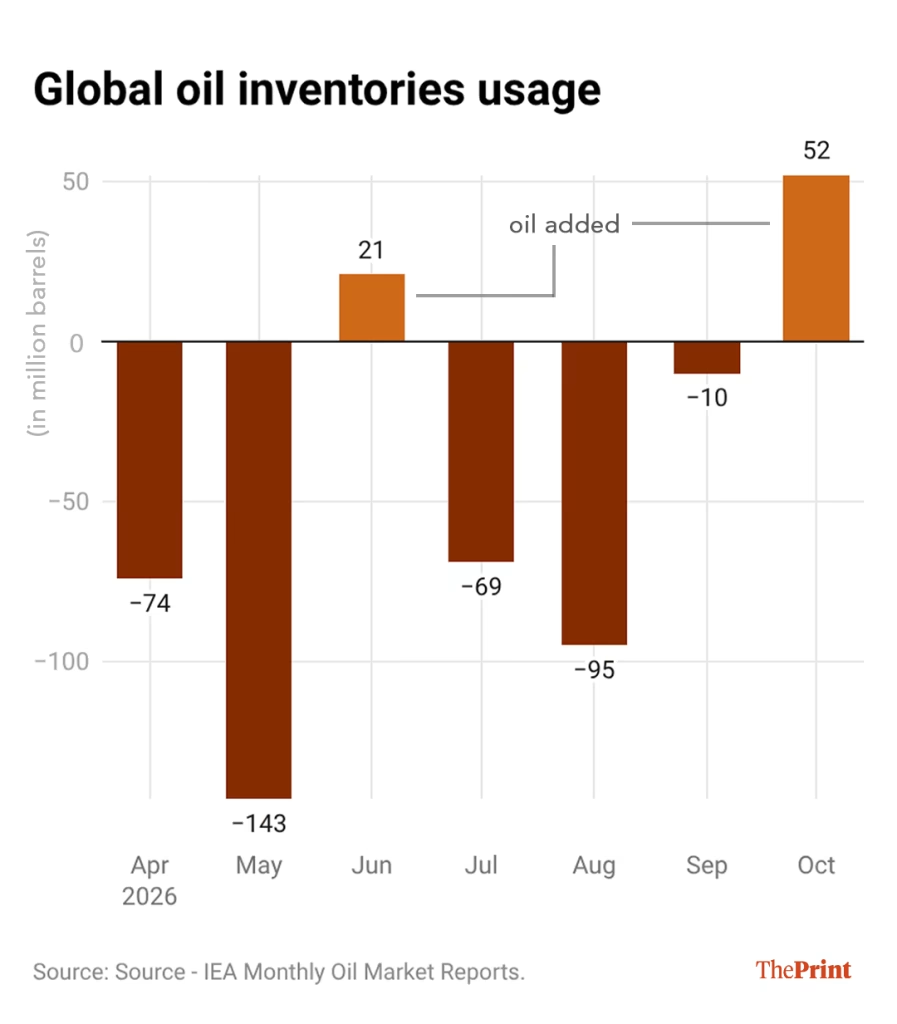
Graphics: ThePrint
The OECD (Organisation for Economic Co-operation and Development), a group of mostly advanced economies, saw their total oil stocks fall by 47 million barrels in October.
US-based energy strategist and geopolitical analyst Umud Shokri said the rise in oil held on ships did not mean that countries had received enough oil in their storage facilities.
He said inventories help countries deal with temporary supply shortages without causing a sharp rise in prices. With stocks now lower, any fresh disruption to shipping routes, oil production or refineries could have a bigger impact on prices.
Also Read: Why India’s go-to Russian oil imports are set to fall & Brazilian supplies may quadruple in November
Replenishment at different speeds
Analysts broadly expect countries to start replenishing at least some of the inventories lost during the crisis in 2027. However, the pace will depend on supply recovery, oil prices and the willingness of governments and companies to purchase additional crude for storage.
Das said rebuilding could begin in early 2027 if supply recovery continues and demand remains relatively weak. He expects the process to be gradual and provide some support to crude prices rather than trigger a sudden price spike.
Shokri also considers early 2027 a realistic possibility, provided global supplies continue recovering and geopolitical tensions ease further. However, he cautioned that restoring inventories to pre-war levels could take much of next year and possibly longer.
June Goh, senior oil market analyst at Sparta Commodities, a market intelligence firm focused on energy markets, said the world would need to replenish some of the lost inventories to maintain a more prudent level of stocks and prepare for another potential supply crisis.
“We have not gone into a position of total peace, which means a disruption in the oil supply chain is still very much possible in the near term,” she told ThePrint.
Natalia Katona, a commodity analyst based in Abu Dhabi, offered a more cautious assessment, arguing that rebuilding inventories is not simply a question of whether oil is available. It also needs to make financial sense.
She explained that the current oil price structure, known as backwardation, discourages companies from storing crude because oil available for immediate delivery is more expensive than oil for future delivery. In contrast, contango, wherein future oil prices are higher than current prices, makes it more attractive to buy and store oil for later sale.
For many OECD countries, the cost of renting storage facilities from private operators is another consideration. Katona said the difference between current and future oil prices needs to cover storage costs to encourage companies to build inventories.
She, therefore, projected that most OECD countries to have limited economic incentive to rebuild strategic reserves in 2027 if the market does not return to contango. Countries with government-owned storage facilities, such as the US and Japan, are likely to have greater flexibility.
The US and Japan could consequently be among the first to replenish their strategic reserves. According to Katona, US inventories declined by around 175 million barrels during the war, including roughly 136 million barrels from its government-owned Strategic Petroleum Reserve (SPR).
The US Department of Energy, she said, had announced that it had secured the return of around 216 million barrels starting in early 2027, although the pace of replenishment had not been specified. Assuming purchases of 100 million barrels annually, she estimated that this could add around 275,000 barrels per day to global oil demand next year.
Japan’s inventories declined by 74 million barrels during the crisis. Replacing this volume over the next year could add another 200,000 barrels per day to demand, she estimated.
Japan, Goh noted, had already started issuing crude tenders to replenish its strategic reserves.
China, meanwhile, is in a different position. Its strategic reserves remained largely untouched during the crisis, with withdrawals concentrated in commercial inventories. According to Katona, China’s commercial stocks declined from 1.26 billion barrels in April to 1.13 billion barrels in November, but remain substantial.
Goh said China’s purchases for its strategic stockpile would depend largely on oil prices, with lower prices likely to encourage more aggressive replenishment.
Supply surplus can complicate recovery
While rebuilding inventories could support crude prices by increasing demand, Katona warned that the market could face a large supply surplus if oil production recovers faster than consumption.
Citing the IEA’s supply-demand outlook, she said supply could exceed demand by around 6 million barrels per day, while demand growth is expected to be 2 million barrels per day. This could leave a surplus of 4 million barrels per day, potentially adding around 1.46 billion barrels to global inventories over a year.
Such a surplus could force oil producers to cut output. Producers with higher production costs, including those in the US, Canada’s oil sands sector and some deepwater projects in Nigeria and Brazil, could face pressure before lower-cost Gulf producers.
Shokri, however, said buying oil to rebuild inventories would support prices. The extent of this support would depend on whether global production recovers enough to meet both regular consumption and additional demand from stock-building.
The oil market faces two competing trends in 2027: countries buying more oil to rebuild depleted inventories while producers increase supplies as Middle Eastern exports recover.
(Edited by Tony Rai)
theprint.in/economy/global-oil-stockpiles-recovering-after-west-asia-war-punch-but-theres-little-room-for-another-shock/3102513/