US attacks on Iranian oil tankers could make it far harder and more expensive for Tehran to keep selling its crude, but the strategy carries a potentially much larger cost: turning the Persian Gulf’s energy infrastructure into an expanding battlefield.
The latest US strikes on three Iranian oil tankers mark a significant escalation in Washington’s economic campaign against Tehran, moving beyond sanctions and blockade to the physical destruction of vessels used to export Iranian oil.
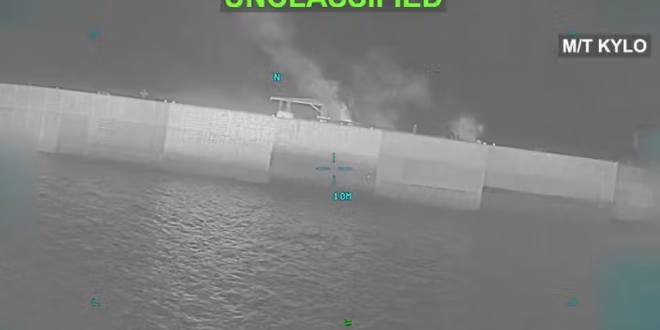
US forces on September 5 disabled two tankers near Kharg Island and Jask and destroyed a third in the Gulf of Oman, according to US Central Command, which described the vessels as part of a “multibillion-dollar shadow network” supporting the IRGC and its regional partners.
The strikes followed Iranian ballistic missile attacks on US naval forces that caused no American casualties. CENTCOM commander Adm. Brad Cooper warned Washington was prepared to impose an “even higher economic cost” on Tehran.
The significance of the strikes lies less in the loss of three ships than in the change in tactics. Washington has spent years trying to make Iranian oil harder to sell through sanctions, restrictions on financial transactions and pressure on buyers and shipping networks. Since mid-July, the US naval blockade has added a physical barrier.
Now, the vessels themselves are becoming targets.
From financial to physical risk
The shift comes as Iran’s oil exports are already under severe pressure.
Ship-tracking data indicated Iranian crude loadings fell to roughly 220,000–255,000 barrels per day in August, from about 740,000 bpd in July and peaks close to 2 million bpd before the conflict.
For weeks, no meaningful Iranian crude cargoes were able to reach China through the Strait of Hormuz, leaving more oil in floating storage inside the Persian Gulf.
Iran has spent years building a shadow shipping network capable of operating around Western sanctions, relying on opaque ownership structures, reflagging, manipulation of vessel-tracking systems and ship-to-ship transfers to move crude, particularly to China.
Those methods are useful when the main challenge is avoiding financial sanctions or detection. They offer far less protection if the vessels themselves become military targets.
Sanctions forced Iran to find ships willing to evade Washington. The new strategy may force it to find ships and crews willing to risk being attacked.
That could make the shadow fleet more expensive and difficult to operate. Many of its tankers are aging vessels already working outside conventional Western insurance and maritime-service networks.
If owners, crews and operators come to regard Iranian-linked voyages as carrying a serious risk of attack, some may demand greater compensation or decide the trade is no longer worthwhile.
Washington cannot, however, simply eliminate the shadow fleet overnight. The network is dispersed and adaptable. Ships can change names, flags and ownership structures, while Tehran can alter loading patterns or move ship-to-ship transfers farther from areas dominated by US forces.
But every vessel lost imposes another cost. Iran must replace it, find another operator willing to accept the risk or leave more crude stranded in storage.
Floating storage offers only temporary relief. Oil held offshore does not generate revenue until it reaches a buyer, and prolonged disruption can eventually force producers to cut output as storage fills.
The question is therefore not whether three tanker strikes can dismantle Iran’s export system. They cannot. It is whether repeated physical losses can gradually undermine the commercial network that has allowed Tehran to keep selling oil despite years of sanctions.
A wider energy battlefield
That strategy carries an obvious risk: once Washington treats Iran’s oil-export system as a military target, Tehran has a stronger incentive to widen the energy battlefield.
Iran has already used attacks and threats against maritime traffic as a means of imposing costs on its adversaries. The Strait of Hormuz remains central to that strategy because of the enormous volumes of oil and liquefied natural gas that normally pass through it.
Further reducing Iranian export revenues could weaken Tehran’s ability to finance the IRGC and allied armed groups while increasing the economic cost of continued confrontation.
But direct attacks on tankers could also reinforce the Iranian leadership’s argument that compromise will not end US pressure and that imposing costs on regional energy flows is one of Tehran’s remaining forms of leverage.
That matters well beyond Iran.
Saudi Arabia and the United Arab Emirates have invested heavily in export routes that partially bypass Hormuz, including Saudi pipelines to the Red Sea and the UAE’s link to Fujairah. But those alternatives cannot fully replace normal flows through the Strait, while Kuwait and Iraq remain particularly dependent on the waterway.
Even without major damage to regional infrastructure, greater insecurity can raise war-risk insurance premiums, freight rates and other costs for commercial operators.
The tanker strikes therefore strengthen Washington’s leverage only if they can impose additional costs on Tehran without triggering a broader contest over the region’s energy infrastructure.
Physical attacks may hurt an Iranian oil-export system that has spent years learning to circumvent sanctions. But they also give Tehran stronger incentives to retaliate against the system through which its neighbors export their own energy.
The strategic gamble for Washington is therefore not simply whether tanker strikes can further squeeze Tehran’s oil revenues. It is whether Iran can be made to bear those costs without deciding that its adversaries’ energy exports should bear them too.

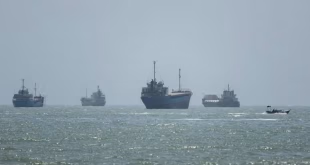
![Numerous merchant ships belonging to Iran and other countries remain at anchor in the Strait of Hormuz in Bandar Abbas, Iran, on September 10, 2026. [Fatemeh Bahrami – Anadolu Agency]](https://uskenergy.com/wp-content/uploads/2026/10/Hormuz-310x165.webp)