With President Donald Trump threatening to launch an “economic D-Day” against Iran, one of the Islamic Republic’s most important wartime lifelines is its geography.
And while the resumption of a U.S. naval blockade last month has substantially limited Iran’s maritime trade, land routes are becoming an increasingly vital source of commerce.
Located at the crossroads of the West, Central and South Asia, Iran shares land borders with seven nations. Each has its own complex history of ties with Tehran, yet they provide unique corridors for trade less susceptible to interception than sea transit.
These routes may not replace Iran’s lucrative maritime trade, but they can help fuel a “resistance economy” fighting to survive the latest U.S. economic onslaught.
“The biggest change since the war is that these routes are no longer just about regional commerce,” Umud Shokri, a senior visiting fellow at George Mason University who specializes in energy and trade networks, told Newsweek. “They have become part of Iran’s economic-survival strategy. Tehran is trying to shift more trade toward land borders, railways, northern ports, and the Caspian.”
“But there are limits,” he added. “Trucks, railways, and smaller northern ports cannot match the scale and efficiency of maritime trade. They can help keep food, consumer goods, and some industrial inputs moving, but they cannot fully replace what Iran has lost through disrupted sea routes.”
Iranian Trade With Land Border Neighbors
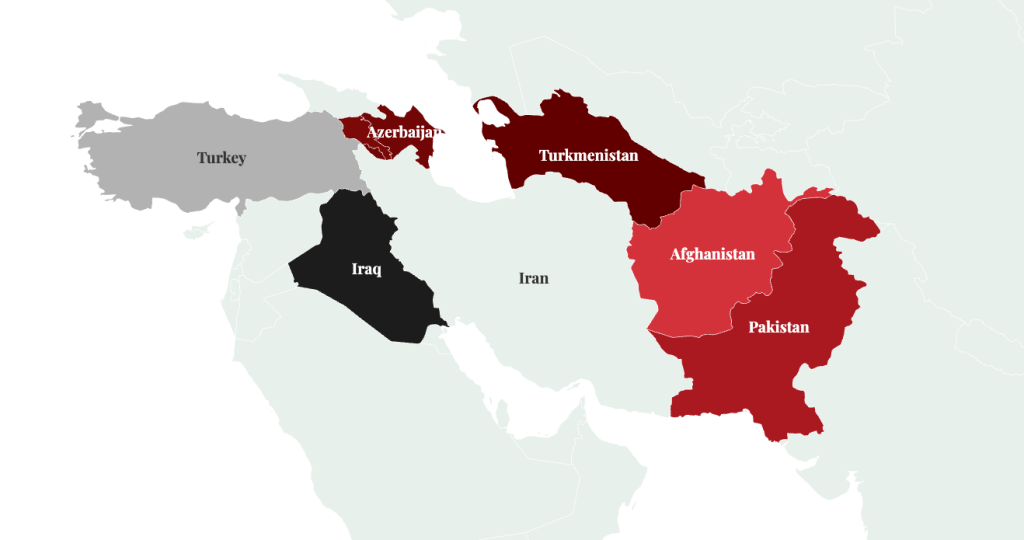
Iraq
Iraq is generally considered Iran’s most important neighbor for trade. They also share their longest border at nearly 1,000 miles.
Ties between Tehran and Baghdad improved substantially after the fall of longtime Iraqi President Saddam Hussein to a U.S.-led invasion in 2003. However, Iran’s influence has proven divisive, especially given its patronage for powerful Shiite Muslim militias that have fought both Sunni Muslim jihadis as well as U.S. troops, all the while consolidating political power.
These groups accelerated their targeting of U.S. and Israeli forces when the ongoing Middle East crisis first erupted with the outbreak of the war in Gaza in October 2023. More recently, they’ve focused their efforts on Saudi Arabia and the United Arab Emirates, creating a new front for Iran and its Axis of Resistance to raise the costs of the U.S.-Israeli war launched in February.
Iran-Iraq ties also have a key economic element, with their trade volume exceeding $10 billion last year. For Iran, the relationship provides an outlet to major markets and connectivity to the rest of the Middle East and the Mediterranean, while Iraq relies heavily on its neighbor for natural gas and electricity.
Washington also considers Baghdad to be a partner; however, any concerted U.S. effort to choke off trade with Iran would likely have severe effects for Iraq. That has not stopped the U.S. from pressuring Iraq to do more to combat Iranian influence, including during the most recent election that took place in Iraq last November.
But as the new Iraqi government seeks to keep the nation out of the fray, officials have shown little appetite for backing an embargo.
Iraqi Supreme Judiciary Council Chief Faiq Zaidan was cited as opposing Trump’s recently announced “Operation Economic Outcast” as he traveled to Iran on Wednesday to meet with senior Iranian officials, including President Masoud Pezeshkian and Parliament Speaker Mohammed Bagher Qalibaf.
Turkey
Turkey is not only a close partner for the U.S. but also a NATO ally whose leader, President Recep Tayyip Erdogan, is often praised by Trump. At the same time, it serves as Iran’s most crucial corridor for long-distance trade, bridging the Middle East and Europe.
Annual trade is estimated at around $5-6 billion, but Turkey’s geographic linkages and distinct geopolitical position elevate the importance of this relationship.
Despite his positive rapport with Trump, Erdogan has repeatedly criticized the U.S. decision to jointly launch the war with Israel against Iran in February. Six months later, he continues to call for an end to the conflict.
Unlike other U.S. allies who have received backlash over their perceived lack of support, Trump doubled down on his admiration for his Turkish counterpart during their latest encounter at the NATO summit hosted last month in July.
But a new White House campaign to target Iran’s trading partners could complicate Erdogan’s calculus, especially as he seeks to deepen relations with Washington in other sectors, such as an F-35 fighter jet acquisition.
The relationship between Turkey and Iran is also complicated. While the two have cooperated in a number of initiatives, including joint opposition to Kurdish separatist movements, Ankara warned Tehran against targeting Arab countries, including Saudi Arabia, with which Turkey and Pakistan recently signed a mutual defense pact.
Pakistan
Pakistan’s decision to join the Mecca Mutual Defense Agreement has put the position of the world’s only nuclear-armed Muslim nation in the spotlight of a rapidly shifting security order in the broader region.
Even before the decision, however, Islamabad took a frontline role in the diplomatic effort to end the war, mediating U.S.-Iran talks and hosting a quadrilateral meeting including representatives of the U.S., Iran and Qatar.
While trade with Iran is relatively modest at around $2.8 billion, Pakistan offers a crucial overland passageway to the Indian Ocean at a time when U.S. warships threaten to intercept ships transiting to and from Iranian ports via the Persian Gulf. In April, when the U.S. blockade first came into effect, Pakistan opened six routes linking major ports in Karachi and Gwadar to land crossings with Iran in Gabd and Taftan.
The same border region was the site of one of Tehran and Islamabad’s most tense episodes in January 2024, when Iran, having weeks earlier suffered the deadliest act of terrorism in its modern history at the hands of the Islamic State militant group (ISIS), conducted strikes against suspected insurgent groups in Pakistan’s Balochistan region. Pakistan retaliated two days later with its own series of strikes against suspected rebels operating in Iran’s Sistan and Baluchestan province.
Both countries quickly de-escalated, seeking joint cooperation on counterterrorism efforts, and relations generally improved. Since the war began, Iranian officials have often credited their Pakistani counterparts with a supportive diplomatic role.
After phone calls with Pakistani Army Chief of Staff Asim Munir and Omani Foreign Minister Badr bin Hamad Al Busaidi, Iranian Foreign Minister Abbas Araghchi stated Wednesday on X that “Iran’s commitment to peace and stability is matched by steadfast diplomacy with our neighbors.”
Azerbaijan
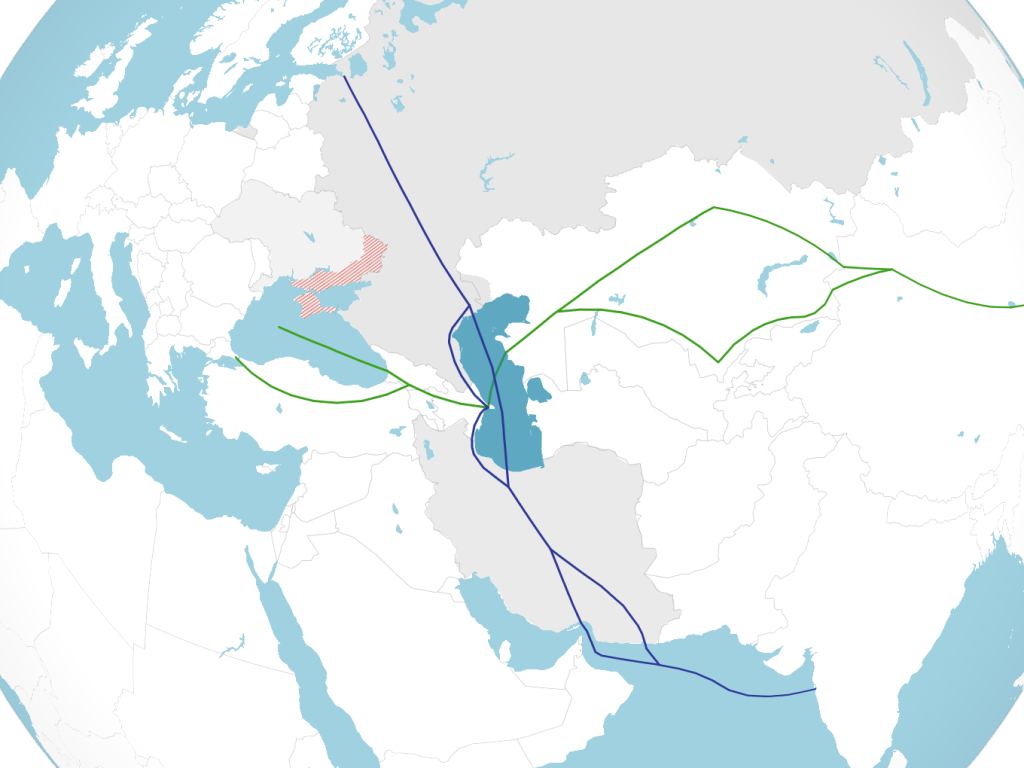
Iran’s trade ties with Azerbaijan are characterized less by their volume than by the country’s role in the broader International North-South Transport Corridor (INSTC), a multimodal network designed to connect India with Russia and northern Europe through Iran and the Caspian region. Azerbaijan forms an important western route within the corridor, linking Iran by rail and road to the Caspian Sea and onward to Russia.
The project has served as a way to move goods without exposure to maritime interdiction or conflict in areas such as the Black Sea, Red Sea, the Suez Canal and the Persian Gulf. As for the Caspian, however, even the enclosed sea has been exposed to disruption in the form of both Israeli and Ukrainian strikes at the intersection of the U.S.-Israeli war against Iran and Russia’s war against Ukraine.
Several factors also contribute to tension in the Iran-Azerbaijan relationship, including growing U.S. influence in the Caucasus, Israel’s close defense cooperation with Baku and the presence of ethnic Azeri separatist movements in Iran’s northwest. In the early days of the war, Azerbaijan reported drone attacks on its territory originating from Iran and claimed to have foiled sabotage plots linked to the Islamic Republic, which has a history of aligning with “Axis of Resistance”-style movements across the border.
Still, ties between Iran and Azerbaijan have stabilized and may even deepen in some areas. Representatives from Moscow and Tehran met Wednesday to advance an agreement that would reportedly see Russia provide Iran with gas using an overland route through Azerbaijan.
Ukraine and Iran wars converge in the Caspian Sea
The International North-South Transport Corridor and the Trans-Caspian International Transport Route
Turkmenistan
The strictly neutral, gas-rich Central Asian state of Turkmenistan has largely stayed out of the politics surrounding the war. However, it did escalate beyond calls for de-escalation to criticize the Ukrainian attack against an Iranian commercial vessel in the Caspian Sea last month.
Turkmenistan’s role as a link for Iran to broader Eurasian trade infrastructure attached to Russia and China is even more significant. This infrastructure was reportedly deemed important enough to be the target of a U.S. cruise missile strike against an Iranian bridge that connects via rail to the border with Turkmenistan.
Later in July, officials from Iran and Turkmenistan discussed enhancing economic cooperation, an initiative reinforced during a separate meeting last week between the two countries’ ambassadors.
Armenia
As with Azerbaijan and Turkmenistan, Armenia’s relationship with Iran is characterized less by overall trade volume and more by mutual strategic benefits. In addition to their arrangement under which Armenia purchases Iranian gas in exchange for electricity, Yerevan and Tehran said Tuesday they want to expand economic exchange in line with a free trade agreement between Iran and the broader Russia-led Eurasian Economic Union (EAEU), of which Armenia is a part.
But shifting tides in the Caucasus may prove problematic.
Armenia’s drift away from Russia’s Collective Security Treaty Organization has been accompanied by a stated desire to apply for European Union membership. Perhaps even more ominous for Tehran, the landmark U.S.-brokered peace deal between Armenia and Azerbaijan includes a corridor known as the “Trump Route for International Peace and Prosperity” (TRIPP), which would traverse Armenia’s Syunik Province along its border with Iran.
Even with this deal in place, landlocked Armenia continues to count on a stable relationship with Iran given its precarious ties and historic enmity with Azerbaijan and Turkey.
Afghanistan
Among Iran’s neighbors, Afghanistan may rank last in trade volume but matters more than it appears in terms of value.
Since the takeover of the Taliban five years ago, Iran has adopted a pragmatic approach despite historically considering the group to be a major regional threat. And with the Taliban-led Afghan government increasingly turning to Iran to wean off economic dependence on Pakistan amid bouts of hostilities and clashes, Tehran and Kabul appear to have established a stable working relationship, even if formal diplomatic recognition has yet to ensue.
That relationship includes a steady stream of trade, with Afghanistan constituting a market for Iranian fuel, food, electricity and various goods.
Perhaps even more crucially, however, Iran views stability in Afghanistan, even under Taliban rule, as crucial to preventing threats from other actors, such as ISIS. Tehran’s deputy ambassador in Kabul won praise from the Afghan government earlier this month after asserting that Iran did not support opposition groups still fighting to unseat the Taliban from power.
Will It Be Enough?
As Iranian journalist Amin Mokarrami recently told Newsweek, “given the large number of neighboring countries, its favorable geographic position and extensive land and maritime borders, Iran has been able to maintain relatively resilient trade channels with neighboring states that are less vulnerable to U.S. sanctions.”
“This has been an important source of economic resilience,” Mokarrami said, describing a situation in which large-scale shortages of goods had yet to manifest despite economic suffering in other areas.
At the same time, he acknowledged that “the capacity of overland transportation simply cannot be compared with the volume that can be moved by sea through the Persian Gulf and the Gulf of Oman.”
“It is true that essential goods, food and medicine are not subject to the sanctions and blockade,” he added. “But a sharp decline in foreign-exchange earnings would inevitably have a major negative impact on Iran’s ability to import even these goods.”
Shokri, for his part, described Iran’s current strategy as an effort “to spread the risk rather than replace maritime trade completely.”
“One part of that strategy is geographical,” Shokri said. “Tehran is using more land routes through Turkey, Iraq, Pakistan, Afghanistan, and Turkmenistan, while also trying to increase the role of northern ports and Caspian shipping. Rail links through Central Asia are also becoming more important because they give Iran another route to China.”
China, by far Iran’s largest trading partner, may prove especially crucial, even as Iran seeks to blunt the economic pain by prioritizing essential industries and capitalizing on decades of experience in sanctions evasion.
“China is the decisive test,” Shokri said. “Iran has experience working around pressure on smaller companies and intermediaries. But if Washington were willing to target major Chinese banks or large state-linked companies, Iran would face a much more serious problem.”
“The difficulty for the U.S. is that this could also trigger a broader confrontation with Beijing,”
Contact Newsweek editors on this story: Jason Lemon and Sam Wilson.

![Numerous merchant ships belonging to Iran and other countries remain at anchor in the Strait of Hormuz in Bandar Abbas, Iran, on September 10, 2026. [Fatemeh Bahrami – Anadolu Agency]](https://uskenergy.com/wp-content/uploads/2026/10/Hormuz-310x165.webp)